
|
You entered: nebula
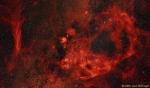 The Gum Nebula
19.05.2006
Named for Australian astronomer Colin Stanley Gum (1924-1960), The Gum Nebula is so large and close it is actually hard to see. In fact, we are only about 450 light-years from the front edge and 1,500 light-years from the back edge of this cosmic cloud of glowing hydrogen gas.
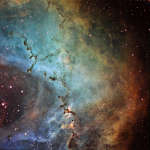 Dust Sculptures in the Rosette Nebula
2.12.2009
What creates the cosmic dust sculptures in the Rosette Nebula? Noted for the common beauty of its overall shape, parts of the Rosette Nebula, also known as NGC 2237, show beauty even when viewed up close.
 NGC 7293: The Helix Nebula
24.10.2024
A mere seven hundred light years from Earth toward the constellation Aquarius, a star is dying. The once sun-like star's last few thousand years have produced the Helix Nebula. Also known...
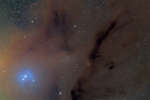 Streaming Dark Nebulas near B44
15.06.2009
Dark dust lit by the bright yellow star Antares highlight this photogenic starscape of the southern sky. A wider angle image shows the central band of our Milky Way Galaxy connected to Antares by streams of dust knows as the Dark River. At the head of the Dark River the dust appears in dense knots.
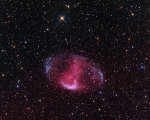 Methuselah Nebula MWP1
21.10.2010
The lovely, symmetric planetary nebula cataloged as MWP1 lies some 4,500 light-years away in the northern constellation Cygnus the Swan. One of the largest planetary nebulae known, it spans about 15 light-years. Based...
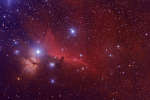 Orion s Horsehead Nebula
21.02.2008
The Horsehead Nebula is one of the most famous nebulae on the sky. It is visible as the dark indentation to the red emission nebula seen just below and left of center in the this photograph. The brightest star on the left is located in the belt of the familiar constellation Orion.
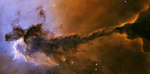 The Fairy of Eagle Nebula
9.12.2007
The dust sculptures of the Eagle Nebula are evaporating. As powerful starlight whittles away these cool cosmic mountains, the statuesque pillars that remain might be imagined as mythical beasts. Pictured above is one of several striking dust pillars of the Eagle Nebula that might be described as a gigantic alien fairy.
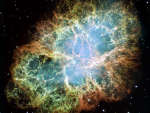 M1: The Crab Nebula from Hubble
17.02.2008
This is the mess that is left when a star explodes. The Crab Nebula, the result of a supernova seen in 1054 AD, is filled with mysterious filaments. The filaments are not only tremendously...
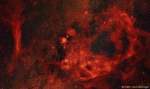 The Gum Nebula
22.08.2009
Named for Australian astronomer Colin Stanley Gum (1924-1960), The Gum Nebula is so large and close it is actually hard to see. In fact, we are only about 450 light-years from the front edge and 1,500 light-years from the back edge of this cosmic cloud of glowing hydrogen gas.
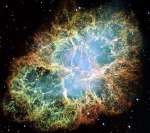 M1: The Crab Nebula from Hubble
25.10.2009
This is the mess that is left when a star explodes. The Crab Nebula, the result of a supernova seen in 1054 AD, is filled with mysterious filaments. The filaments are not only tremendously...
|
January February March April May June July August |
||||||||||||||||||||||||||||||||||||||||||||||||||||||||