
|
You entered: supernova remnant
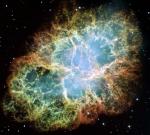 Crab Nebula Mosaic from HST
2.12.2005
The Crab Nebula is cataloged as M1, the first object on Charles Messier's famous list of things which are not comets. In fact, the cosmic Crab is now known to be a supernova remnant, an expanding cloud of debris from the death explosion of a massive star.
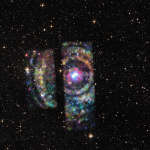 X ray Echoes from Circinus X 1
5.08.2015
Circinus X-1 is an X-ray binary star known for its erratic variability. In the bizarre Circinus X-1 system, a dense neutron star, the collapsed remnant of a supernova explosion, orbits with a more ordinary stellar companion.
 APOD: 2026 March 11 Б CG 4: The Globule and the Galaxy
11.03.2026
Is this a cosmic monster ready to devour an unsuspecting galaxy? Thankfully, that is not the case. The red БmonsterБ shown in the featured image is Cometary Globule CG 4, 1,300 light-years away in the Constellation Puppis.
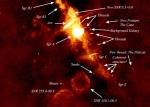 The Galactic Center A Radio Mystery
3.08.2002
Tuning in to the center of our Milky Way galaxy, radio astronomers explore a complex, mysterious place. A premier high resolution view, this startlingly beautiful picture covers a 4x4 degree region around the galactic center.
 M1: The Crab Nebula
9.11.2023
The Crab Nebula is cataloged as M1, the first object on Charles Messier's famous 18th century list of things which are not comets. In fact, the Crab is now known to be a supernova remnant, debris from the death explosion of a massive star witnessed by astronomers in the year 1054.
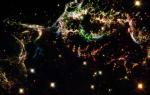 Recycling Cassiopeia A
12.07.2002
For billions of years, massive stars in our Milky Way Galaxy have lived spectacular lives. Collapsing from vast cosmic clouds, their nuclear furnaces ignite and create heavy elements in their cores. After a few million years, the enriched material is blasted back into interstellar space where star formation begins anew.
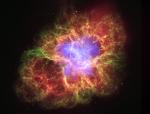 Composite Crab
26.10.2006
The Crab Nebula is cataloged as M1, the first object on Charles Messier's famous list of things which are not comets. In fact, the Crab is now known to be a supernova remnant, expanding debris from the death explosion of a massive star.
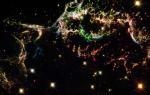 Recycling Cassiopeia A
30.08.2003
For billions of years, massive stars in our Milky Way Galaxy have lived spectacular lives. Collapsing from vast cosmic clouds, their nuclear furnaces ignite and create heavy elements in their cores. After a few million years, the enriched material is blasted back into interstellar space where star formation begins anew.
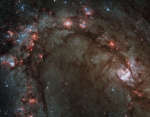 M83s Center from Refurbished Hubble
16.11.2009
What's happening at the center of spiral galaxy M83? Just about everything, from the looks of it. M83 is one of the closest spiral galaxies to our own Milky Way Galaxy and from a distance of 15 million light-years, appears to be relatively normal.
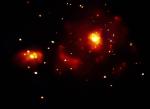 M51: X Rays from the Whirlpool
11.07.2002
Fresh from yesterday's episode, a popular pair of interacting galaxies known as the Whirlpool debut here beyond the realm of visible light -- imaged at high energies by the orbiting Chandra X-ray Observatory. Still turning in a remarkable performance, over 80 glitering x-ray stars are present in the Chandra image data from the region.
|
January February March April May June July August September October |
|||||||||||||||||||||||||||||||||||||||||||||||||