
|
You entered: water
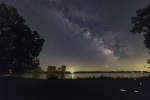 Firefly Trails and the Summer Milky Way
2.07.2016
A camera fixed low to a tripod on a northern summer's eve captured the series of images used in this serene, southern Ontario skyscape. The lakeside view frames our fair galaxy above calm water and the night's quintessential luminous apparitions.
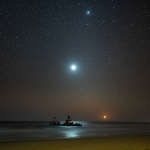 Shipwreck at Moonset
24.11.2018
A crescent Moon is about to sink under the western horizon in this sea and night skyscape. The atmospheric photo was taken on September 11 from the desert shore along the Skeleton Coast of Namibia. So close to moonset, the moonlight is reddened and dimmed by the low, long line-of-sight across the Atlantic.
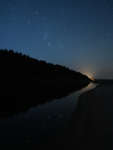 Orion Rising
22.11.2019
Looking toward the east in the early hours of a September morning this single exposure made with tripod and camera captured a simple visual experience. Rising above the tree-lined slope are familiar stars in planet Earth's northern night and the constellation Orion the Hunter.
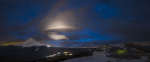 Mt Hood and a Lenticular Cloud
17.04.2013
What kind of cloud is next to that mountain? A lenticular. This type of cloud forms in air that passes over a mountain, rises up again, and cools past the dew point -- so what molecular water carried in the air condenses into droplets.
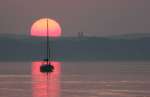 Equinox Sunset
24.09.2009
Often inspiring, or offering a moment for contemplation, a sunset is probably the most commonly photographed celestial event. But this uncommonly beautiful sunset picture was taken on a special day, the Equinox on September 22.
 Iridescent by Moonlight
4.12.2021
In this snapshot from November 18, the Full Moon was not far from Earth's shadow. In skies over Sicily the brightest lunar phase was eclipsed by passing clouds though. The full moonlight was dimmed and momentarily diffracted by small but similar sized water droplets near the edges of the high thin clouds.
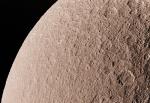 Rhea: Saturn's Second Largest Moon
8.06.2003
Rhea is the second largest moon of Saturn, behind Titan, and the largest without an atmosphere. It is composed mostly of water ice, but has a small rocky core. Rhea's rotation and orbit are locked together (just like Earth's Moon) so that one side always faces Saturn.
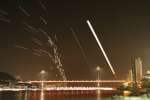 Hong Kong Sky
6.02.2010
This remarkable scene combines multiple exposures recorded on the evening of January 18th from a waterside perspective in Hong Kong, China. It follows a young crescent Moon, with brilliant planet Jupiter to its left, as they set together in the western sky. Their two luminous trails are faintly paralleled by trails of background stars.
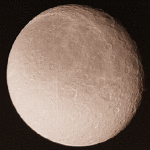 Rhea: Saturn's Second Largest Moon
14.10.1995
Rhea is the second largest moon of Saturn, behind Titan, and the largest without an atmosphere. It is composed mostly of water ice, but has a small rocky core. Rhea's rotation and orbit are locked together (just like Earth's Moon) so that one side always faces Saturn.
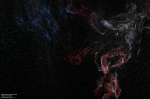 NGC 7841: The Smoke Nebula in Frustriaus
1.11.2013
NGC 7841 is probably known as the Smoke Nebula, found in the modern constellation of Frustriaus, the frustrated astrophotographer. Only a few light-nanoseconds from planet Earth, The Smoke Nebula is not an expanding supernova remnant along the plane of our Milky Way galaxy, though it does look a lot like one.
|
January February March April May June July August September October |
|||||||||||||||||||||||||||||||||||||||||||||||||