
|
You entered: telescope
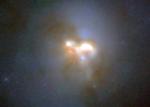 Arp 220: Spirals in Collision
17.06.1997
Arp 220 is the brightest object in the local universe. But why does it shine so brightly? Arp 220 was cataloged as a peculiar galaxy in the 1960s. In the late 1980s, it was discovered to be an ultraluminous infrared galaxy and headed a list compiled from observations with the now-defunct IRAS satellite.
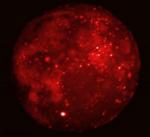 Eclipsed Moon in Infrared
8.11.2003
The total lunar eclipse of September 1996 disappointed many observers in North America who were cursed with cloudy skies. However, the Midcourse Space Experiment (MSX) satellite had a spectacular view from Earth orbit and SPIRIT III, an on board infrared telescope, was used to repeatedly image the moon during the eclipse.
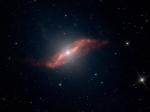 The Galaxy Within Centaurus A
24.06.2004
Peering deep inside Centaurus A, the closest active galaxy to Earth, the Spitzer Space Telescope's penetrating infrared cameras recorded this startling vista. About 1,000 light-years across, the twisted cosmic dust cloud apparently shaped like a parallelogram is likely the result of a smaller spiral galaxy falling into the giant Centaurus A.
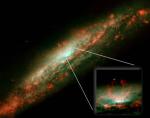 The Bubbling Cauldron of NGC 3079
16.10.2004
Edge-on spiral galaxy NGC 3079 is a mere 50 million light-years away toward the constellation Ursa Major. Shown in this stunning false-color Hubble Space Telescope image, the galaxy's disk - composed of spectacular star clusters in winding spiral arms and dramatic dark lanes of dust - spans some 70,000 light-years.
 Arp 188 and the Tadpoles Tidal Tail
8.01.2006
In this stunning vista recorded with the Hubble Space Telescope's Advanced Camera for Surveys, distant galaxies form a dramatic backdrop for disrupted spiral galaxy Arp 188, the Tadpole Galaxy. The cosmic tadpole is a mere 420 million light-years distant toward the northern constellation Draco.
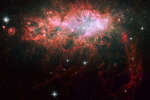 NGC 1569: Starburst in a Dwarf Irregular Galaxy
29.12.2008
Grand spiral galaxies often seem to get all the glory, flaunting their young, bright, blue star clusters in beautiful, symmetric spiral arms. But small, irregular galaxies form stars too. In fact, as pictured here...
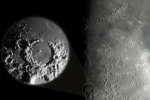 Hesiodus Sunrise Ray
27.03.2010
Stark shadows of mountains and crater walls stand out along the lunar terminator, or shadow line between night and day, in this telescopic image. Of course, if viewed from the lunar surface near the terminator line, the Sun would be rising and still close to the lunar horizon.
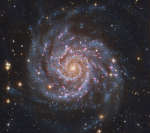 M74: The Perfect Spiral
6.04.2011
If not perfect, then this spiral galaxy is at least one of the most photogenic. An island universe of about 100 billion stars, 32 million light-years away toward the constellation Pisces, M74 presents a gorgeous face-on view.
 Milky Way Galaxy Doomed: Collision with Andromeda Pending
4.06.2012
Will our Milky Way Galaxy collide one day with its larger neighbor, the Andromeda Galaxy? Most likely, yes. Careful plotting of slight displacements of M31's stars relative to background galaxies on recent Hubble...
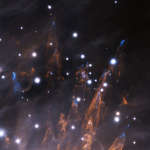 The Orion Bullets
10.01.2013
Cosmic bullets pierce the outskirts of the Orion Nebula some 1500 light-years distant in this sharp infrared close-up. Blasted out by energetic massive star formation the bullets, relatively dense, hot gas clouds about ten times the size of Pluto's orbit, are blue in the false color image.
|
January February March April May June July August September October |
|||||||||||||||||||||||||||||||||||||||||||||||||