
|
You entered: ring
 APOD is 20 Years Old Today
16.06.2015
Welcome to the vicennial year of the Astronomy Picture of the Day! Perhaps a source of web consistency for some, APOD is still here. As during each of the 20 years of selecting images...
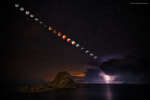 Supermoon Total Lunar Eclipse and Lightning Storm
29.09.2015
What's more rare than a supermoon total lunar eclipse? How about a supermoon total lunar eclipse over a lightning storm. Such an electrifying sequence was captured yesterday from Ibiza, an island in southeastern Spain.
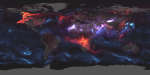 Aerosol Earth
1.09.2018
On August 23, 2018 the identification and distribution of aerosols in the Earth's atmosphere is shown in this dramatic, planet-wide visualization. Produced in real time, the Goddard Earth Observing System Forward Processing (GEOS...
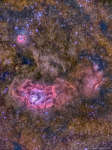 Deep Field: Nebulae of Sagittarius
21.05.2019
These three bright nebulae are often featured on telescopic tours of the constellation Sagittarius and the crowded starfields of the central Milky Way. In fact, 18th century cosmic tourist Charles Messier cataloged two of them; M8, the large nebula just left of center, and colorful M20 on the top left.
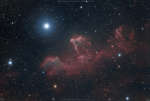 The Ghosts of Cassiopeia
25.10.2019
These bright rims and flowing shapes look ghostly on a cosmic scale. A telescopic view toward the constellation Cassiopeia, the colorful skyscape features swept-back, comet-shaped clouds IC 59 (left) and IC 63. About 600 light-years distant, the clouds aren't actually ghosts.
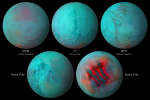 Enceladus in Infrared
24.09.2020
One of our Solar System's most tantalizing worlds, icy Saturnian moon Enceladus appears in these detailed hemisphere views from the Cassini spacecraft. In false color, the five panels present 13 years of infrared image data from Cassini's Visual and Infrared Mapping Spectrometer and Imaging Science Subsystem.
 APOD: 2023 May 30 Б M27: The Dumbbell Nebula
30.05.2023
Is this what will become of our Sun? Quite possibly. The first hint of our Sun's future was discovered inadvertently in 1764. At that time, Charles Messier was compiling a list of diffuse objects not to be confused with comets.
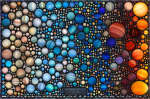 APOD: 2024 July 8 Б Exoplanet Zoo: Other Stars
8.07.2024
Do other stars have planets like our Sun? Surely they do, and evidence includes slight star wobbles created by the gravity of orbiting exoplanets and slight star dimmings caused by orbiting planets moving in front.
 APOD: 2025 February 12 Б Asteroid Bennu Holds the Building Blocks of Life
12.02.2025
What can a space rock tell us about life on Earth? NASA's OSIRIS-REx spacecraft made a careful approach to the near-Earth asteroid 101955 Bennu in October of 2020 to collect surface samples. In September 2023, the robotic spaceship returned these samples to Earth.
 A Year of Assessing Astronomical Hazards
31.12.2002
Could an asteroid destroy civilization on Earth? Mountain-sized space rocks could potentially impact the Earth causing global effects, and perhaps even be mistaken for a nuclear blast of terrestrial origin. Such large impacts are rare but have happened before. Modern telescopes have therefore begun to scan the skies for signs of approaching celestial hazards.
|
January February March April May June July August September October |
|||||||||||||||||||||||||||||||||||||||||||||||||