
|
You entered: Jupiter
 Moon and Planets Over Catalonia
29.02.2012
Venus and Jupiter will appear unusually close in the sky over the next month. The planetary conjunction will be easily visible to the unaided eye because Venus will appear brighter than any background star, and Jupiter will be nearly as bright. To see the near-alignment, simply look to the west after sunset.
 Chasing Juno
12.07.2016
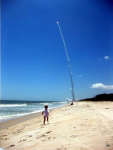
Wait for me! In 2011, NASA's robotic mission Juno launched for Jupiter from Cape Canaveral, Florida, USA. Last week, Juno reached Jupiter and fired internal rockets to become only the second spacecraft to orbit our Solar System's largest planet.
 Crescent Moon Occultation
25.02.2023
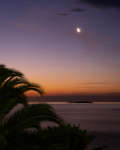
On February 22, a young Moon shared the western sky at sunset with bright planets Venus and Jupiter along the ecliptic plane. The beautiful celestial conjunction was visible around planet Earth. But from some locations Jupiter hid for a while, occulted by the crescent lunar disk.
 Clouds Near Jupiters South Pole from Juno
25.10.2016
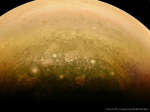
What's happening near the south pole of Jupiter? Recent images sent back by NASA's robotic Juno spacecraft are showing an interesting conglomeration of swirling clouds and what appear to be white ovals.
 Ganymede: The Largest Moon
14.05.2017
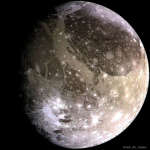
What does the largest moon in the Solar System look like? Jupiter's moon Ganymede, larger than even Mercury and Pluto, has an icy surface speckled with bright young craters overlying a mixture of older, darker, more cratered terrain laced with grooves and ridges.
 Lucy Launches to Eight Asteroids
20.10.2021
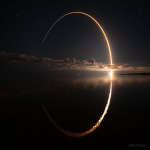
Why would this mission go out as far as Jupiter -- but then not visit Jupiter? Lucy's plan is to follow different leads about the origin of our Solar System than can be found at Jupiter -- where Juno now orbits.
 Jupiters Magnetic Field from Juno
25.02.2020
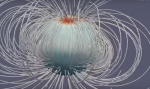
How similar is Jupiter's magnetic field to Earth's? NASA's robotic Juno spacecraft has found that Jupiter's magnetic field is surprisingly complex, so that the Jovian world does not have single magnetic poles like our Earth.
 A Continuous Eruption on Jupiters Moon Io
6.06.2000
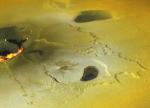
A volcano on Jupiter's moon Io has been photographed recently during an ongoing eruption. Hot glowing lava is visible on the left on this representative-color image. A glowing landscape of plateaus and valleys covered in sulfur and silicate rock surrounds the active volcano.
 Io in True Color
15.07.2001
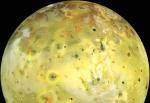
The strangest moon in the Solar System is bright yellow. This picture, showing Io's true colors, was taken in 1999 July by the Galileo spacecraft currently orbiting Jupiter. Io's colors derive from sulfur and molten silicate rock. The unusual surface of Io is kept very young by its system of active volcanoes.
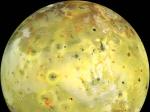 Io in True Color
2.05.2004
The strangest moon in the Solar System is bright yellow. This picture, showing Io's true colors, was taken in 1999 July by the Galileo spacecraft that orbited Jupiter from 1995 to 2003. Io's colors derive from sulfur and molten silicate rock.
|
January February March April May June July August September October |
|||||||||||||||||||||||||||||||||||||||||||||||||