
|
You entered: Large Magellanic Cloud
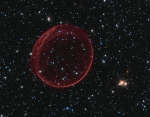 The Rippled Red Ribbons of SNR 0509
25.01.2011
What is causing the picturesque ripples of supernova remnant SNR 0509-67
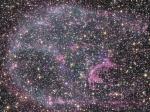 Supernova Remnant N132D in Optical and X Rays
25.10.2005
Thousands of years after a star exploded, its expanding remnant still glows brightly across the spectrum. Such is the case with N132D, a supernova remnant located in the neighboring Large Magellanic Cloud (LMC) galaxy. The expanding shell from this explosion now spans 80 light-years and has swept up about 600 Suns worth of mass.
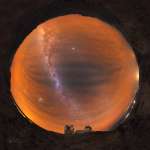 Milky Way vs Airglow Australis
17.05.2018
Captured last week after sunset on a Chilean autumn night, an exceptional airglow floods this allsky view from Las Campanas Observatory. The airglow was so intense it diminished parts of the Milky Way as it arced horizon to horizon above the high Atacama desert.
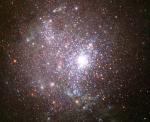 The Stars of NGC 1705
23.04.2003
Some 2,000 light-years across, NGC 1705 is small as galaxies go, similar to our Milky Way's own satellite galaxies, the Magellanic Clouds. At a much larger distance of 17 million light-years...
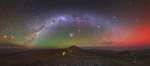 Milky Way with Airglow Australis
3.02.2017
Captured last April after sunset on a Chilean winter's night an exceptionally intense airglow flooded this scene. The panoramic skyscape is also filled with stars, clusters, and nebulae along the southern Milky Way including the Large and Small Magellanic clouds.
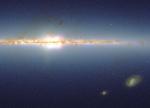 Counting Stars in the Infrared Sky
19.07.2002
The bulging center of our Milky Way Galaxy, dark cosmic clouds, the thin galactic plane, and even nearby galaxies are easy to spot in this sky view. But each pixel in the digital image is actually based on star counts alone -- as derived from the Two Micron All Sky Survey (2MASS) database.
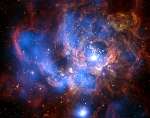 NGC 604: X rays from a Giant Stellar Nursery
5.02.2009
Some 3 million light-years distant in nearby spiral galaxy M33, giant stellar nursery NGC 604 is about 1,300 light-years across, or nearly 100 times the size of the Orion Nebula. In fact, among...
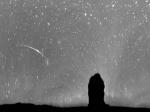 A Taurid Meteor Fireball
15.11.2005
Have you ever seen a very bright meteor? Unexpected, this year's Taurid meteor shower resulted in numerous reports of very bright fireballs during the nights surrounding Halloween. Pictured above, a fireball that momentarily rivaled the brightness of the full Moon was caught over Cerro Pachon, Chile by a continuous sky monitor on November 1.
 New Shocks For Supernova 1987A
17.02.2000
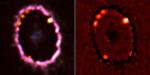
In February of 1987, astronomers witnessed the brightest supernova of modern times - supernova 1987A in the Large Magellanic Cloud. Mysterious rings of material surrounding the expanding stellar debris were soon emitting a visible glow excited by intense light from the explosion.
 Zodiacal Light Over Namibia
13.09.2010
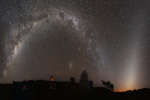
An unusual triangle of light is visible this time of year just before dawn, in the northern hemisphere. Once considered a false dawn, this triangle of light is actually zodiacal light, light reflected from interplanetary dust particles.
|
January February March April May June July August September October |
|||||||||||||||||||||||||||||||||||||||||||||||||