
|
You entered: color
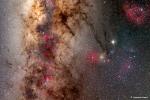 A Scorpio Sky Spectacular
11.09.2007
If Scorpio looked this good to the unaided eye, humans might remember it better. Scorpio more typically appears as a few bright stars in a well known but rarely pointed out zodiacal constellation. To get a spectacular image like this, though, one needs a good camera, color filters, and a digital image processor.
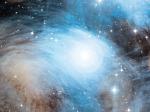 The Merope Reflection Nebula
11.06.2007
Reflection nebulas reflect light from a nearby star. Many small carbon grains in the nebula reflect the light. The blue color typical of reflection nebula is caused by blue light being more efficiently scattered by the carbon dust than red light.
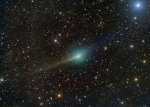 3I/ATLAS Flyby
26.12.2025
Attention grabbing interstellar visitor 3I/ATLAS made its not-so-close flyby of our fair planet on December 19 at a distance of 1.8 astronomical units. That's about 900 light-seconds. This deep exposure captures the comet...
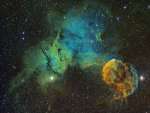 The Elusive Jellyfish Nebula
15.05.2010
Normally faint and elusive, the Jellyfish Nebula is caught in this alluring, false-color, telescopic view. Flanked by two bright stars, Mu and Eta Geminorum, at the foot of a celestial twin, the Jellyfish Nebula is the brighter arcing ridge of emission with dangling tentacles below and right of center.
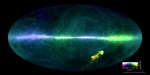 HI4PI: The Hydrogen Sky
24.10.2016
Where are the Milky Way's gas clouds and where are they going? To help answer this question, a new highest-resolution map of the sky in the universe's most abundant gas -- hydrogen -- has been completed and recently released, along with its underlying data.
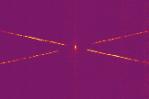 X-Ray Wind From NGC 3783
1.06.2000
A black hole is supposed to inexorably attract matter. But the intense radiation generated as material swirls and plunges into its high gravity field also heats up surrounding gas and drives it away.
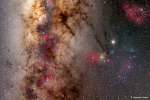 A Scorpius Sky Spectacular
7.04.2019
If Scorpius looked this good to the unaided eye, humans might remember it better. Scorpius more typically appears as a few bright stars in a well-known but rarely pointed out zodiacal constellation. To get a spectacular image like this, though, one needs a good camera, color filters, and a digital image processor.
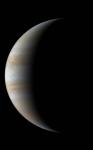 Farewell Jupiter
9.03.2003
Next stop: Saturn. The Cassini spacecraft, launched from Earth in 1997, has now swung past Jupiter and should arrive at Saturn in the year 2004. Pictured to the left is a parting shot from Cassini in January that would not have been possible from Earth: Jupiter showing a crescent phase.
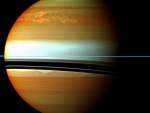 A Raging Storm System on Saturn
28.04.2013
It was one of the largest and longest lived storms ever recorded in our Solar System. First seen in late 2010, the above cloud formation in the northern hemisphere of Saturn started larger than the Earth and soon spread completely around the planet.
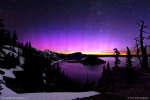 Pink Aurora Over Crater Lake
25.07.2012
Why is this aurora strikingly pink? When photographing picturesque Crater Lake in Oregon, USA last month, the background sky lit up with auroras of unusual colors. Although much is known about the physical mechanisms that create auroras, accurately predicting the occurrence and colors of auroras remains a topic of investigation.
|
January February March April May June July August September October |
|||||||||||||||||||||||||||||||||||||||||||||||||