
|
You entered: dark nebula
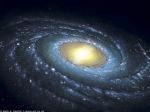 Milky Way Illustrated
4.01.2005
What does our Milky Way Galaxy look like from afar? Since we are stuck inside, and since opaque dust truncates our view in visible light, nobody knows for sure. Drawn above, however, is a good guess based on many different types of observations.
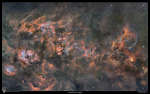 Cygnus Mosaic 2010 2020
11.02.2021
In brush strokes of interstellar dust and glowing gas, this beautiful skyscape is painted across the plane of our Milky Way Galaxy near the northern end of the Great Rift and the constellation Cygnus the Swan.
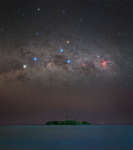 Gems of a Maldivean Night
28.03.2022
The southernmost part of the Milky Way contains not only the stars of the Southern Cross, but the closest star system to our Sun -- Alpha Centauri. The Southern Cross itself is topped by the bright, yellowish star Gamma Crucis.
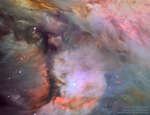 Dust, Gas, and Stars in the Orion Nebula
8.03.2017
The Great Nebula in Orion, an immense, nearby starbirth region, is probably the most famous of all astronomical nebulas. Here, filaments of dark dust and glowing gas surround hot young stars at the edge of an immense interstellar molecular cloud only 1500 light-years away.
 Sagittarius Triplet
14.06.2006
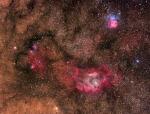
These three bright nebulae are often featured in telescopic tours of the constellation Sagittarius and the crowded starfields of the central Milky Way. In fact, 18th century cosmic tourist Charles Messier cataloged two of them; M8, the nebula below and right of center, and colorful M20 at the upper right.
 Stars and Dust across Corona Australis
22.06.2023
Cosmic dust clouds cross a rich field of stars in this telescopic vista near the northern boundary of Corona Australis, the Southern Crown. Part of a sprawling molecular cloud complex this star forming region is a mere 500 light-years away.
 Thackerays Globules
16.08.2003
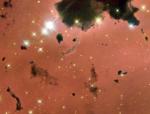
Rich star fields and glowing hydrogen gas silhouette dense, opaque clouds of interstellar gas and dust in this Hubble Space Telescope close-up of IC 2944, a bright star forming region in Centaurus, 5,900 light-years away. The largest of these dark globules, first spotted by South African astronomer A. D.
 Cosmic Clouds in the Unicorn
8.02.2020
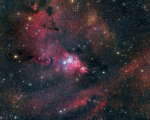
Interstellar clouds of hydrogen gas and dust abound in this gorgeous skyscape. The 3 degree wide field of view stretches through the faint but fanciful constellation Monoceros, the Unicorn. A star forming region cataloged as NGC 2264 is centered, a complex jumble of cosmic gas, dust and stars about 2,700 light-years distant.
 Southern Cross to Eta Carinae
26.04.2019
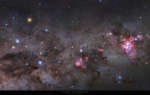
Tracking along the southern Milky Way this beautiful celestial mosaic was recorded under dark Brazilian skies. Spanning some 20 degrees it actually starts with the dark expanse of the Coalsack nebula at the lower left, tucked under an arm of the Southern Cross.
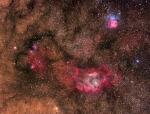 Sagittarius Triplet
4.08.2007
These three bright nebulae are often featured in telescopic tours of the constellation Sagittarius and the crowded starfields of the central Milky Way. In fact, 18th century cosmic tourist Charles Messier cataloged two of them; M8, the nebula below and right of center, and colorful M20 at the upper right.
|
January February March April May June July August September October |
|||||||||||||||||||||||||||||||||||||||||||||||||