
|
You entered: light
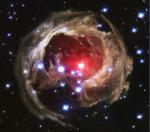 V838 Mon: Echoes from the Edge
5.03.2004
Variable star V838 Monocerotis lies near the edge of our Milky Way Galaxy, about 20,000 light-years from the Sun. Still, ever since a sudden outburst was detected in January 2002, this enigmatic star...
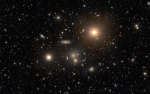 The Hydra Cluster of Galaxies
12.05.2012
Two stars within our own Milky Way galaxy anchor the foreground of this cosmic snapshot. Beyond them lie the galaxies of the Hydra Cluster. In fact, while the spiky foreground stars are hundreds of light-years distant, the Hydra Cluster galaxies are over 100 million light-years away.
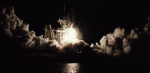 Night Launch of Endeavour
7.08.1995
Space Shuttle Endeavour thunders off into orbit in a rare night launch. This March 1995 mission is most famous for operating the set of astronomical telescopes known as Astro-2. Astro-2's telescopes observed the universe in ultraviolet light - light so blue humans by themselves can't see it.
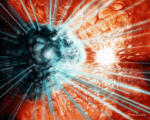 Lasers in Eta Carinae
11.01.1996
Have you heard about the great LASER light show in the sky? Well, nobody had until it was announced just yesterday by a team led by K. Davidson (U. Minnesota) and S. Johansson (U. Lund).
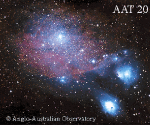 Nebulosity in Sagittarius
10.08.1997
What causes the colors in this beautiful nebulosity in Sagittarius? Dubbed NGC 6589 and NGC 6590, the colors of this nebulosity, are caused by gas and dust. The blue color of the nebula nearest the bright stars is caused by reflection off interstellar dust.
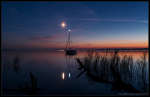 Mars, Antares, Moon, and Saturn
4.10.2014
Mars, Antares, Moon, and Saturn are the brightest celestial beacons in this serene sky. The Sun's golden light is still scattered along the southwestern horizon though, captured after sunset on September 28.
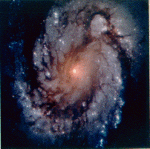 Spiral Galaxy M100
26.06.1995
The M100 galaxy is a large spiral galaxy similar to our own Milky Way, containing over 100 billion stars. It is over 150 million light years away, so the light we see left when dinosaurs roamed the Earth.
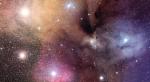 The Colorful Clouds of Rho Ophiuchi
2.06.2004
The many spectacular colors of the Rho Ophiuchi (oh'-fee-yu-kee) clouds highlight the many processes that occur there. The blue regions shine primarily by reflected light. Blue light from the star Rho Ophiuchi and nearby stars reflects more efficiently off this portion of the nebula than red light.
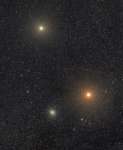 M22 and the Wanderers
12.04.2018
Wandering through the constellation Sagittarius, bright planets Mars and Saturn appeared together in early morning skies over the last weeks. They are captured in this 3 degree wide field-of-view from March 31 in a close celestial triangle with large globular star cluster Messier 22.
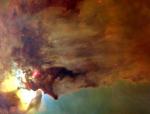 In the Center of the Lagoon Nebula
4.03.2003
The center of the Lagoon Nebula is busy with the awesome spectacle of star formation. Visible in the lower left, at least two long funnel-shaped clouds, each roughly half a light-year long, have been formed by extreme stellar winds and intense energetic starlight. The tremendously bright nearby star, Hershel 36, lights the area.
|
January February March April May June July August September October |
|||||||||||||||||||||||||||||||||||||||||||||||||