
|
You entered: massive stars
 The Cone Nebula from Hubble
28.05.2014
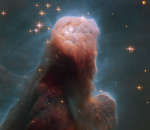
Stars are forming in the gigantic dust pillar called the Cone Nebula. Cones, pillars, and majestic flowing shapes abound in stellar nurseries where natal clouds of gas and dust are buffeted by energetic winds from newborn stars. The Cone Nebula, a well-known example, lies within the bright galactic star-forming region NGC 2264.
 NGC 1818: Pick A Star
15.04.1998
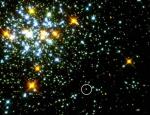
This is NGC 1818, a youthful, glittering cluster of 20,000 stars residing in the Large Magellanic Cloud, 164,000 light-years away. Pick a star. Any star. Astronomers might pick the unassuming bluish-white one (circled) which appears to be a hot newly formed white dwarf star. What makes it so interesting?
 Cartwheel Of Fortune
18.01.2006
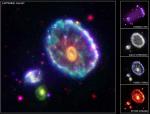
By chance, a collision of two galaxies has created a surprisingly recognizable shape on a cosmic scale - The Cartwheel Galaxy. The Cartwheel is part of a group of galaxies about 400 million light years away in the constellation Sculptor (two smaller galaxies in the group are visible below and left).
 NGC 1818: Pick A Star
31.05.2003
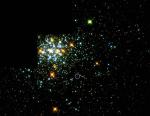
This is NGC 1818, a youthful, glittering cluster of 20,000 stars residing in the Large Magellanic Cloud, 180,000 light-years away. Pick a star. Any star. Astronomers might pick the unassuming bluish-white one (circled) which appears to be a hot newly formed white dwarf star. What makes it so interesting?
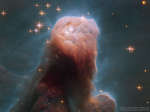 The Cone Nebula from Hubble
15.03.2017
Stars are forming in the gigantic dust pillar called the Cone Nebula. Cones, pillars, and majestic flowing shapes abound in stellar nurseries where natal clouds of gas and dust are buffeted by energetic winds from newborn stars. The Cone Nebula, a well-known example, lies within the bright galactic star-forming region NGC 2264.
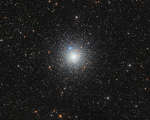 Globular Star Cluster NGC 6752
23.01.2020
Some 13,000 light-years away toward the southern constellation Pavo, the globular star cluster NGC 6752 roams the halo of our Milky Way galaxy. Over 10 billion years old, NGC 6752 follows clusters Omega Centauri and 47 Tucanae as the third brightest globular in planet Earth's night sky.
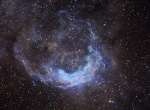 Windblown NGC 3199
22.05.2008
NGC 3199 lies about 12,000 light-years away, a glowing cosmic cloud in the southern constellation of Carina. The nebula is about 75 light-years across in this haunting, false-color view. Though the deep image...
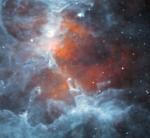 Cold Dust in the Eagle Nebula
14.09.2001
Stars are born in M16's Eagle Nebula, a stellar nursery 7,000 light-years from Earth toward the constellation Serpens. The striking nebula's star forming pillars of gas and dust are familiar to astronomers from images at visible wavelengths, but this false-color picture shows off the nebula in infrared light.
 APOD: 2024 February 4 Б The Cone Nebula from Hubble
4.02.2024
Stars are forming in the gigantic dust pillar called the Cone Nebula. Cones, pillars, and majestic flowing shapes abound in stellar nurseries where natal clouds of gas and dust are buffeted by energetic winds from newborn stars. The Cone Nebula, a well-known example, lies within the bright galactic star-forming region NGC 2264.
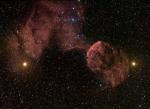 Elusive Jellyfish Nebula
8.04.2004
Normally faint and elusive, the Jellyfish Nebula is caught in the net of this spectacular wide-field telescopic view. Flanked by two yellow-tinted stars at the foot of a celestial twin - Mu and Eta Geminorum - the Jellyfish Nebula is the brighter arcing ridge of emission with dangling tentacles just right of center.
|
January February March April |
|||||||||||||||||||||||||||||||||||||||||||||||||