
|
You entered: planetary nebula
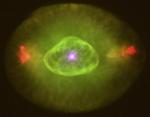 NGC 6826: The Blinking Eye
26.05.2001
The colorful planetary nebula phase of a sun-like star's life is brief. Almost in the "blink of an eye" - cosmically speaking - the star's outer layers are cast off, forming an expanding emission nebula. This nebula lasts perhaps 10 thousand years compared to a 10 billion year stellar life span.
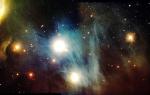 A Chamaeleon Sky
22.03.1999
A photogenic group of nebulae can be found in Chamaeleon, a constellation visible predominantly in skies south of the Earth's equator. Towards Chamaeleon, dark molecular clouds and bright planetary nebula NGC 3195 can be found. Visible near the center of the above photograph is a reflection nebula surrounding a young bright star.
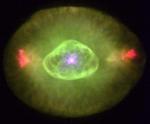 NGC 6826: The Blinking Eye
18.12.1997
The colorful planetary nebula phase of a sun-like star's life is brief. Almost in the "blink of an eye" - cosmically speaking - the star's outer layers are cast off, forming an expanding emission nebula. This nebula lasts perhaps 10 thousand years compared to a 10 billion year stellar life span.
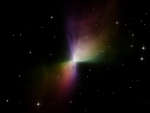 A Beautiful Boomerang Nebula
27.12.2007
This symmetric cloud dubbed the Boomerang Nebula was created by a high-speed wind of gas and dust blowing from an aging central star at speeds of nearly 600,000 kilometers per hour. The rapid...
 APOD: 2024 December 17 Б Near to the Heart Nebula
16.12.2024
What excites the Heart Nebula? First, the large emission nebula on the upper left, catalogued as IC 1805, looks somewhat like a human heart. The nebula glows brightly in red light emitted by its most prominent element, hydrogen, but this long-exposure image was also blended with light emitted by sulfur (yellow) and oxygen (blue).
 Exploring the Ring
18.09.2008
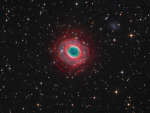
A familiar sight for northern hemisphere astronomers, the Ring Nebula (M57) is some 2,000 light-years away in the musical constellation Lyra. The central ring is about one light-year across, but this remarkably deep...
 The Boomerang Nebula in Polarized Light
14.09.2005
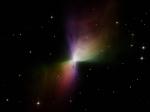
Why did the Boomerang Nebula form? The symmetric cloud dubbed the Boomerang appears to have been created by a high-speed wind of gas and dust blowing from an aging central star at speeds of nearly 600,000 kilometers per hour.
 The Eye of an Hourglass Nebula
8.02.1996
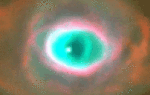
What's happening in the eye-like center of this planetary nebula? The geometry revealed in this Hubble Space Telescope view of the central part of an "etched hourglass nebula" known as MyCn 18 presents a puzzle. First, the axis of this central region does not line up well with the outer hourglass structure.
 Long Lovejoy and Little Dumbbell
26.02.2015
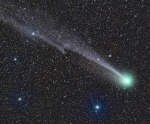
Buffeted by the solar wind, Comet Lovejoy's crooked ion tail stretches over 3 degrees across this telescopic field of view, recorded on February 20. The starry background includes awesome bluish star Phi Persei below, and pretty planetary nebula M76 just above Lovejoy's long tail.
 Cat s Eye Hubble Remix
21.03.2008
Staring across interstellar space, the alluring Cat's Eye Nebula lies three thousand light-years from Earth. One of the most famous planetary nebulae in the sky, the Cat's Eye (NGC 6543) is over half a light-year across and represents a final, brief yet glorious phase in the life of a sun-like star.
|
January February March April May June July August September October |
|||||||||||||||||||||||||||||||||||||||||||||||||