
|
You entered: clouds
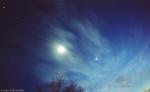 Nashville Four Planet Skyline
9.02.2001
So far this February, evening skies have been blessed with a glorious Moon and three bright planets; Venus, Jupiter, and Saturn. But just last week, on January 30th, an extreme wide-angle lens allowed astrophotographer Larry Koehn to capture this twilight view of Moon and four planets
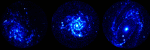 A Spiral Galaxy Gallery
9.04.1996
A progression of beautiful spiral galaxies is illustrated above with three photographs from NASA's Ultraviolet Imaging Telescope (UIT). Flying above the Earth's obscuring layer of atmosphere on the Space Shuttle Columbia during...
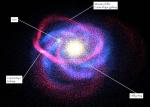 Canis Major Dwarf: A New Closest Galaxy
17.11.2003
What is the closest galaxy to the Milky Way? The new answer to this old question is the Canis Major dwarf galaxy. For many years astronomers thought the Large Magellan Cloud (LMC) was closest, but its title was supplanted in 1994 by the Sagittarius dwarf galaxy.
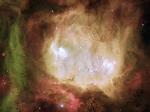 Halloween and the Ghost Head Nebula
31.10.2007
Halloween's origin is ancient and astronomical. Since the fifth century BC, Halloween has been celebrated as a cross-quarter day, a day halfway between an equinox (equal day / equal night) and a solstice (minimum day / maximum night in the northern hemisphere). With our modern calendar, however, the real cross-quarter day will occur next week.
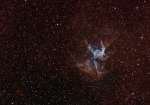 Thor s Helmet (NGC 2359) and Planetary Nebula
12.03.2009
At the right, Thor's Helmet (NGC 2359) seems to gaze across a lovely star field. The broad skyscape itself covers about 1.5 degrees or 3 full moons toward the constellation Canis Major.
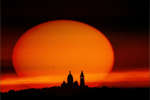 Sunspots and Silhouettes
4.07.2012
What stands between you and the Sun? Apparently, as viewed from Paris last week, one visible thing after another. First, in the foreground, is the Basilica of the Sacred Heart, built in the late 1800s and located on the highest hill in Paris, France.
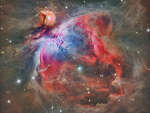 M42: Inside the Orion Nebula
20.03.2013
The Great Nebula in Orion, an immense, nearby starbirth region, is probably the most famous of all astronomical nebulas. Here, glowing gas surrounds hot young stars at the edge of an immense interstellar molecular cloud only 1500 light-years away.
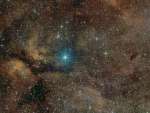 Supergiant Star Gamma Cygni
9.07.2013
Supergiant star Gamma Cygni lies at the center of the Northern Cross, a famous asterism in the constellation of the Swan (Cygnus). Known by the proper name Sadr, the bright star also lies...
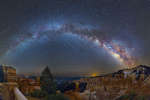 Meteors, Planes, and a Galaxy over Bryce Canyon
19.05.2014
Sometimes land and sky are both busy and beautiful. The landscape pictured in the foreground encompasses Bryce Canyon in Utah, USA, famous for its many interesting rock structures eroded over millions of years.
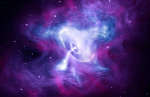 The Crab from Space
17.03.2018
The Crab Nebula is cataloged as M1, the first object on Charles Messier's famous list of things which are not comets. In fact, the Crab is now known to be a supernova remnant, expanding debris from the death explosion of a massive star.
|
January February March April May June July August September October |
|||||||||||||||||||||||||||||||||||||||||||||||||