
|
You entered: planet
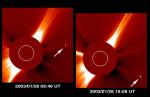 Comet Kudo-Fujikawa: Days in the Sun
30.01.2003
Cruising through the inner Solar System, new Comet Kudo-Fujikawa reached perihelion, its closest approach to the Sun, yesterday, January 29. Passing within 28.4 million kilometers of the Sun, this comet came much closer than innermost planet Mercury basking only 57.9 million kilometers from our parent star.
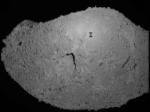 A Robots Shadow on Asteroid Itokawa
16.11.2005
What's that unusual looking spot on asteroid Itokawa? It's the shadow of the robot spacecraft Hayabusa that took the image. Japan's Hayabusa mission arrived at the asteroid in early September and has been imaging and maneuvering around the floating space mountain ever since. The above picture was taken earlier this month.
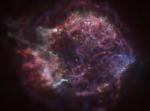 Cas A Supernova Remnant in X Rays
3.01.2000
The complex shell of a star seen to explode 300 years ago is helping astronomers to understand how that star exploded. The above recently released image of supernova remnant Cassiopeia A (Cas A) shows unprecedented detail in three X-ray colors.
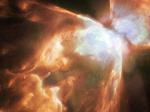 NGC 6302: Big, Bright, Bug Nebula
29.04.2007
The bright clusters and nebulae of planet Earth's night sky are often named for flowers or insects, and NGC 6302 is no exception. With an estimated surface temperature of about 250,000 degrees...
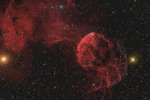 Elusive Jellyfish Nebula
14.05.2009
Normally faint and elusive, the Jellyfish Nebula is caught in this alluring wide-field telescopic view. Flanked by two yellow-tinted stars, Mu and Eta Geminorum, at the foot of a celestial twin, the Jellyfish Nebula is the brighter arcing ridge of emission with dangling tentacles right of center.
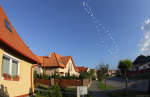 Analemma 2010
31.12.2010
Looking back on the year, have you wondered where the Sun was in the sky each day during 2010 at exacty 9am UT? Of course you have. Search no further for the answer! It was somewhere along this celestial figure 8 curve known as an analemma.
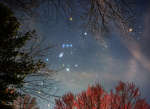 Orion Spring
25.03.2015
As spring comes to planet Earth's northern hemisphere, familiar winter constellation Orion sets in early evening skies and budding trees frame the Hunter's stars. The yellowish hue of cool red supergiant Alpha Orionis, the great star Betelgeuse, mingles with the branches at the top of this colorful skyscape.
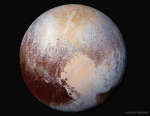 Pluto in Enhanced Color
31.08.2015
Pluto is more colorful than we can see. Color data and images of our Solar System's most famous dwarf planet, taken by the robotic New Horizons spacecraft during its flyby in July, have been digitally combined to give an enhanced view of this ancient world sporting an unexpectedly young surface.
 Pluto from above Cthulhu Regio
14.09.2015
New high resolution images of Pluto are starting to arrive from the outer Solar System. The robotic New Horizons spacecraft, which zoomed by Pluto in July, has finished sending back some needed engineering data and is now transmitting selections from its tremendous storehouse of images of Pluto and its moons.
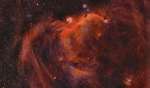 The Seagull and The Duck
16.03.2018
Seen as a seagull and a duck, these nebulae are not the only cosmic clouds to evoke images of flight. But both are winging their way across this broad celestial landscape, spanning almost 7 degrees across planet Earth's night sky toward the constellation Canis Major.
|
January February March April May June July August September October |
|||||||||||||||||||||||||||||||||||||||||||||||||