
|
You entered: Sun
 APOD: 2024 October 30 Б NGC 7635: The Bubble Nebula
30.10.2024
What created this huge space bubble? Blown by the wind from a star, this tantalizing, head-like apparition is cataloged as NGC 7635, but known simply as the Bubble Nebula. The featured striking view utilizes a long exposure to reveal the intricate details of this cosmic bubble and its environment.
 APOD: 2024 November 4 Б M42: The Great Nebula in Orion
4.11.2024
The Great Nebula in Orion, an immense, nearby starbirth region, is probably the most famous of all astronomical nebulas. Here, glowing gas surrounds hot young stars at the edge of an immense interstellar molecular cloud only 1500 light-years away.
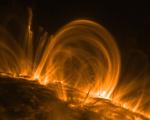 Heating Coronal Loops
28.09.2000
Extending above the photosphere or visible surface of the Sun, the faint, tenuous solar corona can't be easily seen from Earth, but it is measured to be hundreds of times hotter than the photosphere itself. What makes the solar corona so hot?
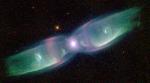 M2-9: Wings of a Planetary Nebula
23.12.1997
Are stars better appreciated for their art after they die? Actually, stars usually create their most artistic displays as they die. In the case of low-mass stars like our Sun and M2-9 pictured above, the stars transform themselves from normal stars to white dwarfs by casting off their outer gaseous envelopes.
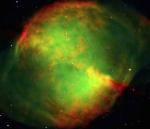 M27: Not A Comet
24.04.2004
While searching the skies above 18th century France for comets, astronomer Charles Messier diligently recorded this object as number 27 on his list of things which are definitely not comets. So what is it?
 An Inner Neptune for 55 Cancri
1.09.2004
Is our Solar System unique? The discovery of a Neptune-mass planet in an sub-Mercury orbit around nearby Sun-like star 55 Cancri, announced yesterday along with the discovery of other similar systems, gives a new indication that planetary systems as complex as our own Solar System likely exist elsewhere.
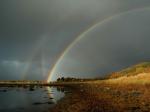 Six Rainbows Across Norway
12.09.2007
Have you ever seen six rainbows at once? They are not only rare to see -- they are a puzzle to understand. The common rainbow is caused by sunlight internally reflected by the backs of falling raindrops, while also being refracted at the air / water boundary.
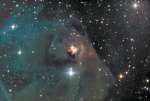 T Tauri and Hind s Variable Nebula
13.12.2007
The orange star centered in this remarkable telescopic skyview is T Tauri, protoytpe of the class of T Tauri variable stars. Nearby it is a dusty yellow cosmic cloud historically known as Hind's Variable Nebula (aka NGC 1555/1554).
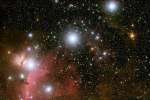 Orion s Belt
10.02.2009
Alnitak, Alnilam, and Mintaka, are the bright bluish stars from east to west (left to right) along the diagonal in this gorgeous cosmic vista. Otherwise known as the Belt of Orion, these three blue supergiant stars are hotter and much more massive than the Sun.
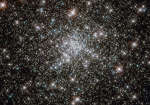 At the Core of NGC 6752
10.02.2012
This sharp Hubble Space Telescope view looks deep into NGC 6752. Some 13,000 light-years away toward the southern constellation Pavo, the globular star cluster roams the halo of our Milky Way galaxy. Over...
|
January February March April May June July August September October |
|||||||||||||||||||||||||||||||||||||||||||||||||