
|
You entered: star
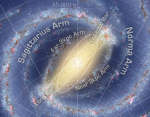 The Far 3kpc Arm
11.07.2008
A major discovery was lurking in the data. By accident, while preparing a talk on the Galaxy's spiral arms for a meeting of the American Astronomical Society, Tom Dame (Harvard-Smithsonian CfA) found it - a new spiral arm in the Milky Way.
 The Great Carina Nebula
9.06.2011
A jewel of the southern sky, the Great Carina Nebula, also known as NGC 3372, spans over 300 light-years, one of our galaxy's largest star forming regions. Like the smaller, more northerly Great...
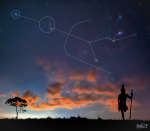 A Historic Brazilian Constellation
11.01.2021
The night sky is filled with stories. Cultures throughout history have projected some of their most enduring legends onto the stars above. Generations of people see these stellar constellations, hear the associated stories, and pass them down.
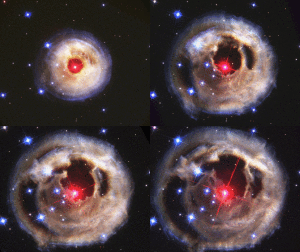 V838 Light Echo: The Movie
2.04.2003
What caused this outburst of V838 Mon? For reasons unknown, star V838 Mon's outer surface suddenly greatly expanded with the result that it became the brightest star in the entire Milky Way Galaxy. Then, just as suddenly, it faded.
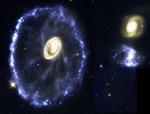 Cartwheel of Fortune
22.02.1997
By chance, a collision of two galaxies has created a surprisingly recognizable shape on a cosmic scale - "The Cartwheel Galaxy". The Cartwheel is part of a group of galaxies about 500 million light years away in the constellation of Sculptor (two smaller galaxies in the group are visible on the right).
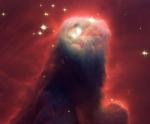 Cone Nebula Close Up
29.05.2004
Cones, pillars, and majestic flowing shapes abound in stellar nurseries where natal clouds of gas and dust are buffeted by energetic winds from newborn stars. A well-known example, the Cone Nebula within the bright galactic star-forming region NGC 2264, was captured in this close-up view from the Hubble Space Telescope's Advanced Camera for Surveys.
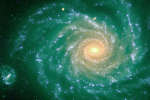 Grand Spiral Galaxy NGC 1232
24.08.2008
Galaxies are fascinating not only for what is visible, but for what is invisible. Grand spiral galaxy NGC 1232, captured in detail by one of the new Very Large Telescopes, is a good example.
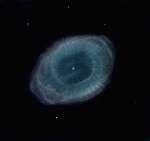 Ring Nebula Drawn
15.09.2012
A planetary nebula with a simple symmetry familiar to telescopic sky gazers, the Ring Nebula (M57) is some 2,000 light-years away in the musical constellation Lyra. Hints of changing colors and subtle details are brought out in this remarkable sketch of the cosmic ring.
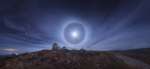 Halo from Atacama
17.05.2016
Influenced by the strong Pacific El Nino, cloudy skies have more often come to Chile's high Atacama Desert this season, despite its reputation as an astronomer's paradise. Located...
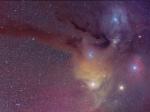 The Dark River to Antares
9.08.2004
Connecting the Pipe Nebula to the bright star Antares is a flowing dark cloud nicknamed the Dark River. The murkiness of the Dark River is caused by absorption of background starlight by dust, although the nebula contains mostly hydrogen and molecular gas.
|
January February March April May June July August September October |
|||||||||||||||||||||||||||||||||||||||||||||||||