
|
You entered: stars
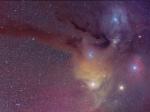 The Dark River to Antares
9.08.2004
Connecting the Pipe Nebula to the bright star Antares is a flowing dark cloud nicknamed the Dark River. The murkiness of the Dark River is caused by absorption of background starlight by dust, although the nebula contains mostly hydrogen and molecular gas.
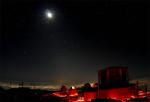 Moon Over Haleakala
10.06.2006
A waxing crescent Moon shines over the caldera of dormant volcano Haleakala and observatory domes in this dramatic view from above the clouds. Looking west from Maui, Hawaii on May 31st, the scene also records the lights of Honolulu on the horizon.
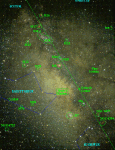 The Annotated Galactic Center
11.09.1999
The sky toward the center of our Galaxy is filled with a wide variety of celestial wonders. Many are easily visible with binoculars. Constellations near the galactic center include Sagittarius, Libra, Scorpius, Scutum, and Ophiuchus. Nebulae include Messier Objects M8, M16, M17, M20 and the Pipe Nebula.
 Iridescent by Moonlight
4.12.2021
In this snapshot from November 18, the Full Moon was not far from Earth's shadow. In skies over Sicily the brightest lunar phase was eclipsed by passing clouds though. The full moonlight was dimmed and momentarily diffracted by small but similar sized water droplets near the edges of the high thin clouds.
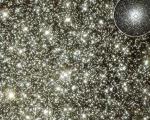 Unusual Flashes Toward Globular Cluster M22
3.07.2001
What is causing the unusual flashes behind globular cluster M22? This teaming ball of stars is the brightest globular cluster visible in Earth's northern hemisphere. M22, shown in full in the inset, spans about 50 light years away and lies 8500 light-years toward the constellation of Sagittarius.
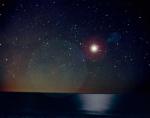 1006 AD: Supernova in the Sky
28.03.2003
A new star, likely the brightest supernova in recorded human history, appeared in planet Earth's sky in the year 1006 AD. The expanding debris cloud from the stellar explosion is still visible to modern astronomers, but what did the supernova look like in 1006?
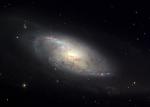 M106 in Canes Venatici
17.04.2003
Close to the Great Bear (Ursa Major) and surrounded by the stars of the Hunting Dogs (Canes Venatici), this celestial nebula was discovered in 1781 by the metric French astronomer Pierre Mechain and later added to the catalog of his friend and colleague Charles Messier as M106.
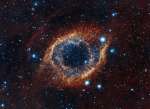 The Helix Nebula from the VISTA Telescope
31.01.2012
Will our Sun look like this one day? The Helix Nebula is one of brightest and closest examples of a planetary nebula, a gas cloud created at the end of the life of a Sun-like star.
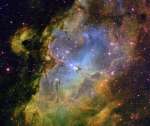 The Eagle Nebula from Kitt Peak
16.04.2012
From afar, the whole thing looks like an Eagle. A closer look at the Eagle Nebula, however, shows the bright region is actually a window into the center of a larger dark shell of dust. Through this window, a brightly-lit workshop appears where a whole open cluster of stars is being formed.
 Seagull to Sirius
15.12.2016
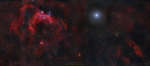
This broad, beautiful mosaic spans almost 20 degrees across planet Earth's sky. The nebula-rich region lies near the edge of the Orion-Eridanus supperbubble, filled with looping, expanding shells of gas and dust embedded in molecular clouds near the plane of the Milky Way Galaxy.
|
January February March April May June July August September October |
|||||||||||||||||||||||||||||||||||||||||||||||||