
|
You entered: ring
 Asteroids Near Earth
1.10.2011
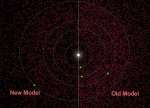
Though the sizes are not to scale, the Sun and planets of the inner solar system are shown in this illustration, where each red dot represents an asteroid. New results from NEOWISE, the infrared...
 MACS 1206: A Galaxy Cluster Gravitational Len
17.10.2011
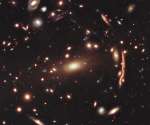
It is difficult to hide a galaxy behind a cluster of galaxies. The closer cluster's gravity will act like a huge lens, pulling images of the distant galaxy around the sides and greatly distorting them.
 A Perseid Below
10.08.2014
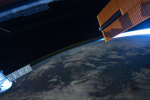
Denizens of planet Earth typically watch meteor showers by looking up. But this remarkable view, captured on August 13, 2011 by astronaut Ron Garan, caught a Perseid meteor by looking down. From Garan...
 NGC 2736: The Pencil Nebula
14.07.2016
Moving from top to bottom in the frame near the center of this sharply detailed color composite, thin, bright, braided filaments are actually long ripples in a cosmic sheet of glowing gas seen almost edge-on. The shock wave plows through interstellar space at over 500,000 kilometers per hour.
 Stephan's Quintet from Hubble
2.06.2019
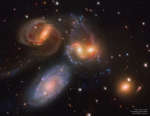
When did these big galaxies first begin to dance? Really only four of the five of Stephan's Quintet are locked in a cosmic tango of repeated close encounters taking place some 300 million light-years away.
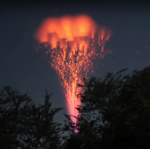 Gigantic Jet Lightning from Puerto Rico
28.09.2021
Have you ever seen a gigantic jet? They are extremely rare but tremendously powerful. Gigantic jets are a type of lightning discharge documented only this century that occur between some thunderstorms and the Earth's ionosphere high above them.
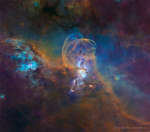 Star Forming Region NGC 3582 without Stars
19.09.2022
What's happening in the Statue of Liberty nebula? Bright stars and interesting molecules are forming and being liberated. The complex nebula resides in the star forming region called RCW 57, and besides the iconic monument, to some looks like a flying superhero or a weeping angel.
 APOD: 2023 April 19 Б Auroral Storm over Lapland
18.04.2023
On some nights the sky is the best show in town. On this night, auroras ruled the sky, and the geomagnetic storm that created this colorful sky show originated from an increasingly active Sun.
 APOD: 2023 July 9 Б Doomed Star Eta Carinae
8.07.2023
Eta Carinae may be about to explode. But no one knows when - it may be next year, it may be one million years from now. Eta Carinae's mass - about 100 times greater than our Sun - makes it an excellent candidate for a full blown supernova.
 APOD: 2023 November 7 Б A Martian Dust Devil Spins By
6.11.2023
It moved across the surface of Mars -- what was it? A dust devil. Such spinning columns of rising air are heated by the warm surface and are also common in warm and dry areas on planet Earth.
|
January February March April May June July August September October |
|||||||||||||||||||||||||||||||||||||||||||||||||