
|
You entered: gas
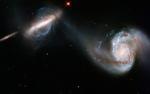 Peculiar Arp 87
31.10.2007
A cosmic bridge of stars, gas, and dust stretches for over 75,000 light-years and joins this peculiar pair of galaxies cataloged as Arp 87. The bridge is strong evidence that these two immense star systems have passed close to each other and experienced violent tides induced by mutual gravity.
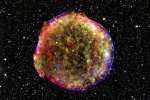 Tychos Supernova Remnant
16.03.2009
What star created this huge puffball? Pictured above is the best multi-wavelength image yet of Tycho's supernova remnant, the result of a stellar explosion first recorded over 400 years ago by the famous astronomer Tycho Brahe.
 Arp 87: Merging Galaxies from Hubble
8.12.2015
This dance is to the death. Along the way, as these two large galaxies duel, a cosmic bridge of stars, gas, and dust currently stretches over 75,000 light-years and joins them. The bridge...
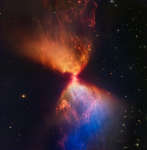 The Protostar within L1527
17.11.2022
The protostar within dark cloud L1527 is a mere 100,000 years old, still embedded in the cloud of gas and dust that feeds its growth. In this NIRCam image from the James Webb...
 APOD: 2024 July 23 Б The Crab Nebula from Visible to X Ray
22.07.2024
What powers the Crab Nebula? A city-sized magnetized neutron star spinning around 30 times a second. Known as the Crab Pulsar, it is the bright spot in the center of the gaseous swirl at the nebula's core.
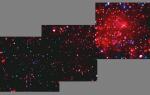 X Ray Stars and Winds in the Rosette Nebula
19.10.2001
This mosaic of x-ray images cuts a swath across the photogenic Rosette Nebula, a stellar nursery 5,000 light-years from Earth in the constellation Monoceros, the Unicorn. Constructed from data recorded by the orbiting...
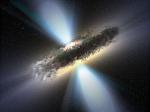 Molecular Torus Surrounds Black Hole
8.09.2004
Why do some black hole surroundings appear brighter than others? In the centers of active galaxies, supermassive black holes at least thousands of times the mass of our Sun dominate. Many, called Seyfert Type I, are very bright in visible light. Others, called Seyfert Type II, are rather dim.
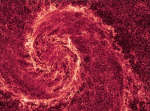 The Whirlpool Galaxy in Infrared Dust
25.01.2011
How do spiral galaxies form stars? To help find out, the Hubble Space Telescope imaged the nearby photogenic spiral M51 in infrared light to highlight the dust that traces the dense gas that best forms stars. To further isolate the dust, much of the optical light from stars has also been digitally removed.
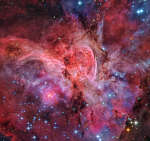 Carina Nebula Close Up
14.02.2020
A jewel of the southern sky, the Great Carina Nebula, also known as NGC 3372, spans over 300 light-years, one of our galaxy's largest star forming regions. Like the smaller, more northerly Great...
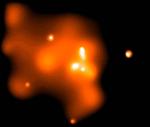 X-Rays From The Galactic Center
19.01.2000
Exploring quasars and active galaxies in the distant universe, astronomers have come to believe that most galaxies have massive black holes at their centers. Swirling stars and a strong, variable radio source offer convincing evidence that even our own Milky Way galaxy's center harbors such a bizarre object, a mere 30,000 light-years away.
|
January February March April May June July August September October |
|||||||||||||||||||||||||||||||||||||||||||||||||