
|
You entered: light
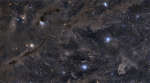 A Dark and Dusty Sky
22.05.2015
In the dusty sky toward the constellation Taurus and the Orion Arm of our Milky Way Galaxy, this broad mosaic follows dark and faint reflection nebulae along the region's fertile molecular cloud.
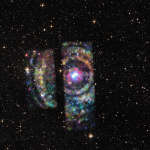 X ray Echoes from Circinus X 1
5.08.2015
Circinus X-1 is an X-ray binary star known for its erratic variability. In the bizarre Circinus X-1 system, a dense neutron star, the collapsed remnant of a supernova explosion, orbits with a more ordinary stellar companion.
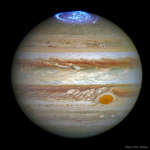 Aurorae on Jupiter
11.07.2016
Jupiter has aurorae. Like Earth, the magnetic field of the gas giant funnels charged particles released from the Sun onto the poles. As these particles strike the atmosphere, electrons are temporarily knocked away from existing gas molecules. Electric force attracts these electrons back. As the electrons recombine to remake neutral molecules, auroral light is emitted.
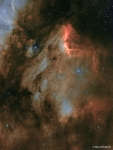 IC 5070: A Dusty Pelican in the Swan
19.11.2016
The recognizable profile of the Pelican Nebula soars nearly 2,000 light-years away in the high flying constellation Cygnus, the Swan. Also known as IC 5070, this interstellar cloud of gas and dust...
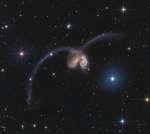 Exploring the Antennae
28.04.2017
Some 60 million light-years away in the southerly constellation Corvus, two large galaxies are colliding. Stars in the two galaxies, cataloged as NGC 4038 and NGC 4039, very rarely collide in the course of the ponderous cataclysm that lasts for hundreds of millions of years.
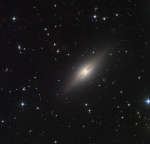 NGC 7814: The Little Sombrero in Pegasus
30.06.2017
Point your telescope toward the high flying constellation Pegasus and you can find this expanse of Milky Way stars and distant galaxies. Dominated by NGC 7814, the pretty field of view would almost be covered by a full moon.
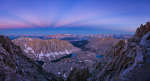 Planet Earth at Blue Hour
11.10.2019
Nature photographers and other fans of planet Earth always look forward to the blue hour. That's the transition in twilight, just before sunrise or after sunset, when the Sun is below the horizon but land and sky are still suffused with beautiful bluish hues of light.
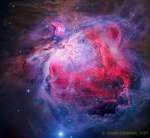 M42: Inside the Orion Nebula
30.10.2019
The Great Nebula in Orion, an immense, nearby starbirth region, is probably the most famous of all astronomical nebulas. Here, glowing gas surrounds hot young stars at the edge of an immense interstellar molecular cloud only 1500 light-years away.
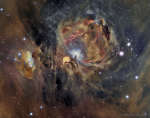 Orion Nebula in Oxygen, Hydrogen, and Sulfur
4.10.2020
Few astronomical sights excite the imagination like the nearby stellar nursery known as the Orion Nebula. The Nebula's glowing gas surrounds hot young stars at the edge of an immense interstellar molecular cloud.
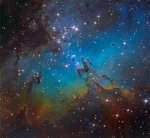 M16 Close Up
9.09.2021
A star cluster around 2 million years young surrounded by natal clouds of dust and glowing gas, M16 is also known as The Eagle Nebula. This beautifully detailed image of the region adopts the colorful Hubble palette and includes cosmic sculptures made famous in Hubble Space Telescope close-ups of the starforming complex.
|
January February March April May June July August September October |
|||||||||||||||||||||||||||||||||||||||||||||||||