
|
You entered: rings
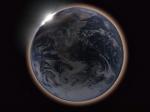 Solar Eclipse from the Moon
1.03.2007
Parts of Saturday's (March 3) lunar eclipse will be widely visible. For example, skywatchers in Europe, Africa, and western Asia will be able to see the entire spectacle of the Moon gliding through Earth's shadow, but in eastern North America the Moon will rise already in its total eclipse phase.
 Betelgeuse Resolved
5.08.2009
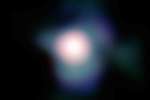
The sharpest image ever of Betelgeuse shows a mammoth star that is slowly evaporating. Betelgeuse (sounds a lot like "beetle juice"), also known as Alpha Orionis, is one of the largest and brightest stars known. The star is a familiar orange fixture easily visible to the unaided eye toward the constellation of Orion.
 Huygens Lands on Titan
15.01.2015
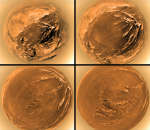
Delivered by Saturn-bound Cassini, ESA's Huygens probe touched down on the ringed planet's largest moon Titan, ten years ago on January 14, 2005. These panels show fisheye images made during its slow descent by parachute through Titan's dense atmosphere.
 Evidence of an Active Volcano on Venus
13.01.2020
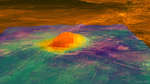
Are volcanoes still active on Venus? More volcanoes are known on Venus than Earth, but when Venusian volcanoes last erupted is not directly known. Evidence bolstering very recent volcanism on Venus has recently been uncovered, though, right here on Earth.
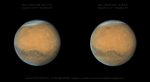 Stereo Mars
2.12.2022
Mars looks sharp in these two rooftop telescope views captured in late November from Singapore, planet Earth. At the time, Mars was about 82 million kilometers from Singapore and approaching its opposition, opposite the Sun in planet Earth's sky on December 8.
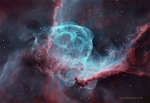 APOD: 2026 June 9 Б Thors Helmet
8.06.2026
Thor not only has his own day (Thursday), but a helmet in the heavens. Popularly called Thor's Helmet, NGC 2359 is a hat-shaped cosmic cloud with wing-like appendages. Heroically sized even for a Norse god, Thor's Helmet is about 30 light-years across.
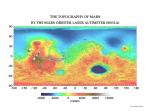 The Topography of Mars
28.06.2001
Mars has its ups and downs. Visible on the above interactive topographic map of the surface of Mars are giant volcanoes, deep valleys, impact craters, and terrain considered unusual and even mysterious. Particularly notable...
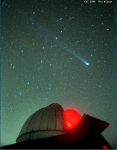 Hyakutake, Big Dipper, and Observatory Dome
1.04.1996
In one of the more spectacular pictures yet taken, Comet Hyakutake is shown here on March 26 high in the dark Missouri sky. In the foreground is Elmcrest Observatory complete with a dim red light glowing inside the dome.
 A Note on the Perseus Cluster
12.09.2003
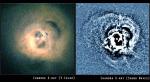
A truly enormous collection of thousands of galaxies, the Perseus Cluster - like other large galaxy clusters - is filled with hot, x-ray emitting gas. The x-ray hot gas (not the individual galaxies) appears in the left panel above, a false color image from the Chandra Observatory.
 SOFIA s Window Seat
24.02.2006
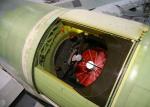
Earlier this month, a 2.5-meter diameter infrared telescope was permanently assigned a window seat, looking through this opening in the fuselage of a historic Boeing 747 aircraft. The telescope mirror, about the size of the Hubble Space Telescope mirror, is protected by a red covering.
|
January February March April May June July August September October |
|||||||||||||||||||||||||||||||||||||||||||||||||