
|
You entered: Earth orbit
 Aurora Australis and the International Space Station
13.09.2024
This snapshot from the International Space Station was taken on August 11 while orbiting about 430 kilometers above the Indian Ocean, Southern Hemisphere, planet Earth. The spectacular view looks south and east, down toward the planet's horizon and through red and green curtains of aurora australis.
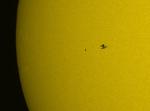 Sharp Silhouette
21.09.2006
Though it's 93 million miles away, the Sun still hurts your eyes when you look at it. But bright sunlight (along with accurate planning and proper equipment!) resulted in this sharp silhouette of spaceship and space station.
 A Year of Assessing Astronomical Hazards
31.12.2002
Could an asteroid destroy civilization on Earth? Mountain-sized space rocks could potentially impact the Earth causing global effects, and perhaps even be mistaken for a nuclear blast of terrestrial origin. Such large impacts are rare but have happened before. Modern telescopes have therefore begun to scan the skies for signs of approaching celestial hazards.
 APOD: 2024 February 26 Б Martian Moon Eclipses Martian Moon
26.02.2024
What if there were two moons in the sky -- and they eclipsed each other? This happens on Mars. The featured video shows a version of this unusual eclipse from space. Pictured are the two moons of Mars: the larger Phobos, which orbits closer to the red planet, and the smaller Deimos, which orbits further out.
 APOD: 2023 June 30 Б Orbits of Potentially Hazardous Asteroids
30.06.2023
Are asteroids dangerous? Some are, but the likelihood of a dangerous asteroid striking the Earth during any given year is low. Because some past mass extinction events have been linked to asteroid impacts, however, humanity has made it a priority to find and catalog those asteroids that may one day affect life on Earth.
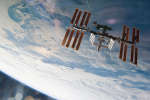 The International Space Station from Above
3.03.2010
The International Space Station (ISS) is the largest human-made object ever to orbit the Earth. The ISS is so large that it can be seen drifting overhead with the unaided eye, and is frequently imaged from the ground in picturesque fashion.
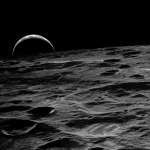 Apollo 14 Heads for Home
5.02.2021
Fifty years ago this Sunday (February 7, 1971), the crew of Apollo 14 left lunar orbit and headed for home. They watched this Earthrise from their command module Kittyhawk. With Earth's sunlit crescent just peeking over the lunar horizon, the cratered terrain in the foreground is along the lunar farside.
 Comet ATLAS and the Mighty Galaxies
21.03.2020
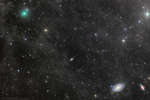
Comet ATLAS C/2019 Y4 was discovered by the NASA funded Asteroid Terrestrial-impact Last Alert System, the last comet discovery reported in 2019. Now growing brighter in northern night skies, the comet's pretty greenish...
 APOD: 2025 July 2 Б Milky Way Through Otago Spires
2.07.2025
Does the Milky Way always rise between these two rocks? No. Capturing this stunning alignment took careful planning: being in the right place at the right time. In the featured image taken in June...
 Asteroid 2012 DA14 Passes the Earth
17.02.2013
There it goes. That small spot moving in front of background stars in the above video is a potentially dangerous asteroid passing above the Earth's atmosphere. This past Friday, the 50-meter wide asteroid...
|
January February March April May June July August September October |
|||||||||||||||||||||||||||||||||||||||||||||||||