
|
You entered: Orion Nebula
 APOD: 2023 May 1 Б Carina Nebula North
1.05.2023
The Great Carina Nebula is home to strange stars and iconic nebulas. Named for its home constellation, the huge star-forming region is larger and brighter than the Great Orion Nebula but less well known because it is so far south -- and because so much of humanity lives so far north.
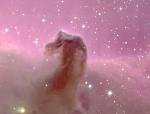 The Horsehead Nebula
16.12.2001
One of the most identifiable nebulae in the sky, the Horsehead Nebula in Orion, is part of a large, dark, molecular cloud. Also known as Barnard 33, the unusual shape was first discovered on a photographic plate in the late 1800s.
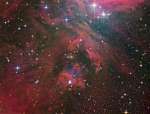 South of Orion
3.04.2008
This tantalizing array of nebulae and stars can be found about 2 degrees south of the famous star-forming Orion Nebula. The region abounds with energetic young stars producing jets and outflows that push through the surrounding material at speeds of hundreds of kilometers per second.
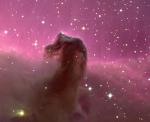 The Horsehead Nebula
19.05.1999
One of the most identifiable nebulae in the sky, the Horsehead Nebula in Orion, is part of a large, dark, molecular cloud. Also known as Barnard 33, the unusual shape was first discovered on a photographic plate in the late 1800s.
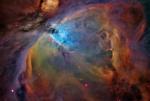 An Orion of a Different Color
25.03.2004
Look up into the sky tonight, and even with a good telescope you won't come across a sight quite like this one. It is a familiar object though, the grand stellar nursery known as the Orion Nebula.
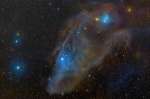 IC 4592: A Blue Horsehead
21.05.2009
This complex of beautiful, dusty reflection nebulae lies in the constellation Scorpius along the plane of our Milky Way Galaxy. Its overall outline suggests a horsehead in profile, though it covers a much larger region than the better known Horsehead Nebula of Orion.
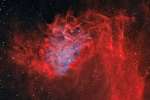 AE Aurigae and the Flaming Star Nebula
11.03.2011
AE Aurigae is the bright star below and left of center in this evocative portrait of IC 405, also known as the Flaming Star Nebula. Embedded in the cosmic cloud, the hot, variable O-type star energizes the glow of hydrogen along convoluted filaments of atomic gas, its blue starlight scattered by interstellar dust.
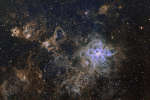 The Cosmic Web of the Tarantula Nebula
11.01.2011
It is the largest and most complex star forming region in the entire galactic neighborhood. Located in the Large Magellanic Cloud, a small satellite galaxy orbiting our Milky Way galaxy, the region's spidery appearance is responsible for its popular name, the Tarantula nebula. This tarantula, however, is about 1,000 light-years across.
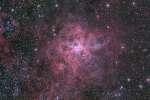 The Cosmic Web of the Tarantula Nebula
17.02.2014
It is the largest and most complex star forming region in the entire galactic neighborhood. Located in the Large Magellanic Cloud, a small satellite galaxy orbiting our Milky Way galaxy, the region's spidery appearance is responsible for its popular name, the Tarantula nebula. This tarantula, however, is about 1,000 light-years across.
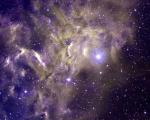 AE Aurigae: The Flaming Star
4.12.2001
Is star AE Aurigae on fire? Although surrounded by what may look like smoke, the object known as the "flaming star" creates energy primarily by nuclear fusion, like other stars. Fire, typically defined...
|
January February March April May June July August September October |
|||||||||||||||||||||||||||||||||||||||||||||||||