
|
You entered: cassini spacecraft
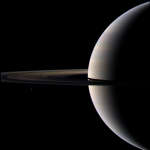 Saturn After Equinox
10.11.2009
The other side of Saturn's ring plane is now directly illuminated by the Sun. For the previous 15 years, the southern side of Saturn and its rings were directly illuminated, but since Saturn's equinox in August, the orientation has reversed.
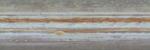 Jupiter Unpeeled
6.09.2003
Slice Jupiter from pole to pole, peel back its outer layers of clouds, stretch them onto a flat surface ... and for all your trouble you'd end up with something that looks a lot like this. Scrolling right will reveal the full picture, a color mosaic of Jupiter from the Cassini spacecraft.
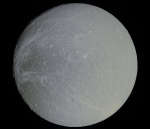 Saturns Moon Dione in Slight Color
5.11.2012
Why does one half of Dione have more craters than the other? Start with the fact that Saturn's moon Dione has one side that always faces Saturn, and one side that always faces away. This is similar to Earth's Moon.
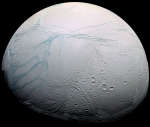 Fresh Tiger Stripes on Saturns Enceladus
6.04.2014
Do underground oceans vent through the tiger stripes on Saturn's moon Enceladus? Long features dubbed tiger stripes are known to be spewing ice from the moon's icy interior into space, creating a cloud of fine ice particles over the moon's South Pole and creating Saturn's mysterious E-ring.
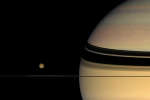 Moons, Rings, and Unexpected Colors on Saturn
20.10.2008
Why would Saturn show such strange colors? The robotic Cassini spacecraft currently orbiting Saturn has beamed back images showing that the northern hemisphere our Solar System's most spectacularly ringed planet has changed noticeably since Cassini arrived in 2004, now sporting unusual and unexpected colors. No one is sure why.
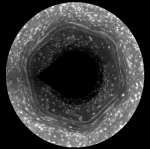 Saturns Hexagon Comes to Light
14.12.2009
Believe it or not, this is the North Pole of Saturn. It is unclear how an unusual hexagonal cloud system that surrounds Saturn's north pole was created, keeps its shape, or how long it will last.
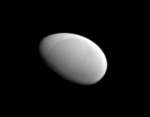 Methone: Smooth Egg Moon of Saturn
6.11.2012
Why is this moon shaped like a smooth egg? The robotic Cassini spacecraft completed the first flyby ever of Saturn's small moon Methone in May and discovered that the moon has no obvious craters.
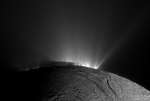 Shadows and Plumes Across Enceladus
4.08.2014
Why does Enceladus have ice plumes? The discovery of jets spewing water vapor and ice was detected by the Saturn-orbiting Cassini spacecraft in 2005. The origin of the water feeding the jets, however, remained a topic of research.
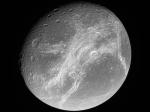 Bright Cliffs Across Saturns Moon Dione
5.09.2006
What causes the bright streaks on Dione? Recent images of this unusual moon by the robot Cassini spacecraft now orbiting Saturn are helping to crack the mystery. Close inspection of Dione's trailing hemisphere, pictured above, indicates that the white wisps are composed of deep ice cliffs dropping hundreds of meters.
 Cassini Approaches Saturn
15.03.2011
What would it look like to approach Saturn in a spaceship? One doesn't have to just imagine -- the Cassini spacecraft did just this in 2004, recording thousands of images along the way, and thousands more since entering orbit.
|
January February March April May June July August September October |
|||||||||||||||||||||||||||||||||||||||||||||||||