
|
You entered: dark nebula
 Our Galaxy in Stars, Gas, and Dust
28.09.2003
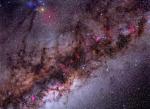
The disk of our Milky Way Galaxy is home to hot nebulae, cold dust, and billions of stars. The red nebulae visible in the above contrast-enhanced picture are primarily emission nebulae, glowing clouds of hydrogen gas heated by nearby, bright, young stars.
 APOD: 2026 May 25 Б Thackerays Globules
25.05.2026
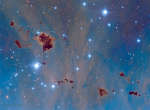
What are these strange space globs? Situated in rich star fields and glowing hydrogen gas, these opaque clouds of interstellar dust and gas are so large they might be able to form stars. Their...
 Northern Cygnus
20.09.2007
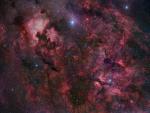
Bright, hot, supergiant star Deneb lies at top center in this gorgeous skyscape. The 20 frame mosaic spans an impressive 12 degrees across the northern end of Cygnus the Swan. Crowded with stars...
 Our Galaxy in Stars, Gas, and Dust
27.09.1999
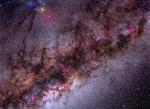
The disk of our Milky Way Galaxy is home to hot nebulae, cold dust, and billions of stars. The red nebulae visible in the above contrast-enhanced picture are primarily emission nebulae, glowing clouds of hydrogen gas heated by nearby, bright, young stars.
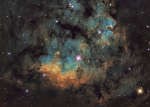 NGC 7822 in Cepheus
20.01.2022
Hot, young stars and cosmic pillars of gas and dust seem to crowd into NGC 7822. At the edge of a giant molecular cloud toward the northern constellation Cepheus, the glowing star forming region lies about 3,000 light-years away. Within the nebula, bright edges and dark shapes stand out in this colorful telescopic skyscape.
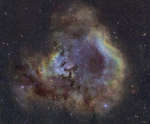 NGC 7822 in Cepheus
11.11.2016
Hot, young stars and cosmic pillars of gas and dust seem to crowd into NGC 7822. At the edge of a giant molecular cloud toward the northern constellation Cepheus, the glowing star forming region lies about 3,000 light-years away. Within the nebula, bright edges and dark shapes stand out in this colorful skyscape.
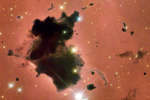 Thackerays Globules
28.12.2008
Rich star fields and glowing hydrogen gas silhouette dense, opaque clouds of interstellar gas and dust in this Hubble Space Telescope close-up of IC 2944, a bright star forming region in Centaurus, 5,900 light-years away. The largest of these dark globules, first spotted by South African astronomer A. D.
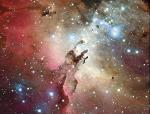 The Eagle Nebula from CFHT
13.02.2003
Bright blue stars are still forming in the dark pillars of the Eagle Nebula. Made famous by a picture from the Hubble Space Telescope in 1995, the Eagle Nebula shows the dramatic process of star formation. To the upper right of the nebula in the above picture lies the heart of the open cluster M16.
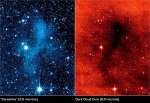 Coreshine from a Dark Cloud
30.09.2010
Stars and their planets are born in cold, dark, interstellar clouds of gas and dust. While exploring the clouds at infrared wavelengths, astronomers have made a surprising discovery -- dozens of cases where dense cloud cores shine by reflecting infrared starlight.
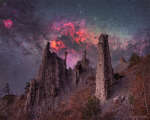 Milky Way over French Alp Hoodoos
16.05.2022
Real castles aren't this old. And the background galaxy is even older. Looking a bit like an alien castle, the pictured rock spires are called hoodoos and are likely millions of years old. Rare, but found around the world, hoodoos form when dense rocks slow the erosion of softer rock underneath.
|
January February March April May June July August September October |
|||||||||||||||||||||||||||||||||||||||||||||||||