
|
You entered: dust disk
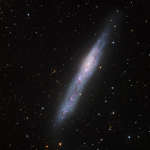 Magellanic Galaxy NGC 55
11.07.2019
Irregular galaxy NGC 55 is thought to be similar to the Large Magellanic Cloud (LMC). But while the LMC is about 180,000 light-years away and a well-known satellite of our own Milky Way Galaxy, NGC 55 is more like 6 million light-years distant, a member of the Sculptor Galaxy Group.
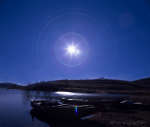 Meteors vs Supermoon
15.12.2016
Geminid meteors battled supermoonlight in planet Earth's night skies on December 13/14. Traveling at 35 kilometers (22 miles) per second, the bits of dust from the mysterious asteroid 3200 Phaethon that produce the meteor streaks are faster than a speeding bullet.
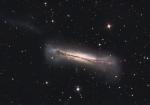 Sideways Galaxy NGC 3628
8.04.2005
Dark dust lanes cutting across the middle of this gorgeous island universe strongly hint that NGC 3628 is a spiral galaxy seen sideways. About 35 million light-years away in the northern springtime constellation...
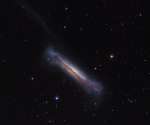 Sideways Galaxy NGC 3628
15.03.2011
Dark dust lanes cut across the middle of this gorgeous island universe, a strong hint that NGC 3628 is a spiral galaxy seen sideways. About 35 million light-years away in the northern springtime constellation...
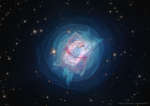 Bright Planetary Nebula NGC 7027 from Hubble
29.06.2020
What created this unusual planetary nebula? NGC 7027 is one of the smallest, brightest, and most unusually shaped planetary nebulas known. Given its expansion rate, NGC 7027 first started expanding, as visible from Earth, about 600 years ago.
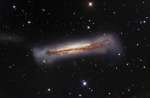 Sideways Galaxy NGC 3628
15.05.2008
Dark dust lanes cut across the middle of this gorgeous island universe, a strong hint that NGC 3628 is a spiral galaxy seen sideways. About 35 million light-years away in the northern springtime constellation...
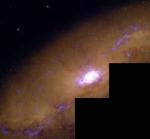 NGC 1808: A Nearby Starburst Galaxy
1.07.1998
NGC 1808 is a galaxy in turmoil. A barred spiral with marked similarities to our home Milky Way Galaxy, NGC 1808 is distinguished by a peculiar nucleus, an unusually warped disk, and strange flows of hydrogen gas out from the central regions.
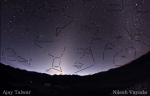 Zodiacal Light and the False Dawn
16.01.2012
Is it dawn or false dawn? During certain times of the year, the horizon near the rising Sun will begin to glow unusually early. This early glow does not originate directly from the Sun, but rather from sunlight reflected by interplanetary dust.
 The Arms of M106
6.02.2013
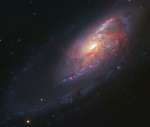
The spiral arms of bright galaxy M106 sprawl through this remarkable multiframe portrait, composed of data from ground- and space-based telescopes. Also known as NGC 4258, M106 can be found toward the northern constellation Canes Venatici. The well-measured distance to M106 is 23.5 million light-years, making this cosmic scene about 80,000 light-years across.
 Starbirth in NGC 1808
22.03.1998
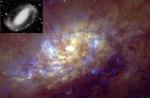
The center of galaxy NGC 1808 is bursting with new stars, but why? Being a barred spiral galaxy makes NGC 1808 somewhat similar to our own Milky Way Galaxy. But the disk of NGC 1808 (inset) is quite warped, and its center is unusually bright and blue.
|
January February March April May June July August |
||||||||||||||||||||||||||||||||||||||||||||||||||||||||