
|
You entered: evening sky
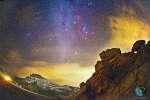 Deep Orion Over the Canary Islands
23.01.2012
Which attracts your eye more -- the sky or the ground? On the ground are rocky peaks in Teide National Park on Tenerife Island of the Spanish Canary Islands off the northwestern coast of Africa. The volcanic landscape features old island summits and is sometimes used as a testbed for instruments on future Martian rovers.
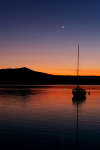 Conjunction at Sunset
29.12.2011
While Comet Lovejoy entertained early morning risers in in the southern hemisphere, a lovely conjunction of a young crescent Moon and Venus graced western skies at sunset. Captured on December 26th the conjunction, with beautiful sunset colors above and below, is seen here over Viverone Lake near Turin, Italy.
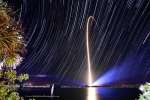 Rocket Streak and Star Trails
30.01.2014
Fixed to a tripod and looking east across the Kennedy Space Center's Turn Basin, a camera captured these star trails as a series of short exposures over a three hour period on the evening of January 23rd.
 Jupiter by Moonlight
3.11.2023
That bright beacon you've seen rising in the east just after sunset is Jupiter. Climbing high in midnight skies, our Solar System's ruling gas giant was at its 2023 opposition, opposite the Sun in planet Earth's sky, on November 2.
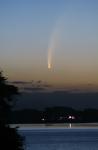 Southern Comet
18.01.2007
After a remarkable performance in the northern hemisphere, the brightest comet in decades is now showing off in the south. Recorded during evening twilight on January 17, this view features the bright coma...
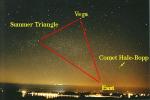 Vega
Vega
15.07.1997
Vega is a bright blue star 25 light years away. Vega is the brightest star in the Summer Triangle, a group of stars easily visible summer evenings in the northern hemisphere. The name Vega...
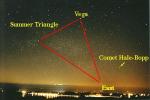 Vega
Vega
23.08.1998
Vega is a bright blue star 25 light years away. Vega is the brightest star in the Summer Triangle, a group of stars easily visible summer evenings in the northern hemisphere. The name Vega...
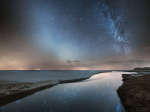 Dueling Bands in the Night
27.02.2018
What are these two bands in the sky? The more commonly seen band is the one on the right and is the central band of our Milky Way galaxy. Our Sun orbits...
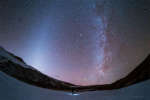 Dueling Bands in the Night
1.03.2022
What are these two bands in the sky? The more commonly seen band is the one on the right and is the central band of our Milky Way galaxy. Our Sun orbits...
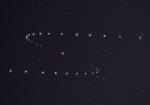 S is for Venus
7.01.2005
Planet Venus traced out this S shape in Earth's sky during 2004. Following the second planet from the Sun in a series of 29 images recorded from April 3rd through August...
|
January February March April May June July August September |
|||||||||||||||||||||||||||||||||||||||||||||||||