
|
You entered: wind
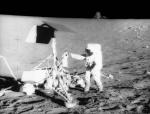 Apollo 12 Visits Surveyor 3
3.03.2001
Apollo 12 was the second mission to land humans on the Moon. The landing site was picked to be near the location of Surveyor 3, a robot spacecraft that had landed on the Moon three years earlier.
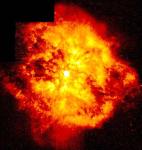 WR124: Stellar Fireball
9.11.1998
Some stars explode in slow motion. Rare, massive Wolf-Rayet stars are so tumultuous and hot they are disintegrating right before our telescopes. Glowing gas globs each over 30 times more massive than the Earth are being expelled by a violent stellar wind.
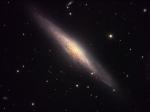 NGC 2683: Spiral Edge On
27.11.2004
This gorgeous island universe, cataloged as NGC 2683, lies a mere 16 million light-years distant in the northern constellation Lynx. A spiral galaxy comparable to our own Milky Way, NGC 2683 is seen nearly edge-on in this cosmic vista, with more distant galaxies scattered in the background.
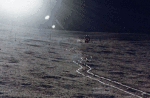 Apollo 14: Rickshaw Tracks Across the Moon
27.04.1996
Brilliant sunlight glints off tracks gently winding across the the Moon's Frau Maro highlands. The tracks were made by the Apollo 14 crew's two-wheeled Modularized Equipment Transporter (MET), fondly known as the "rickshaw". The MET was designed as an aid to surface exploration.
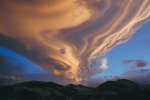 A Lenticular Cloud Over New Zealand
21.01.2009
What's happening above those mountains? Several clouds are stacked up into one striking lenticular cloud. Normally, air moves much more horizontally than it does vertically. Sometimes, however, such as when wind comes off of a mountain or a hill, relatively strong vertical oscillations take place as the air stabilizes.
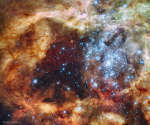 Star Cluster R136 Breaks Out
10.01.2021
In the center of nearby star-forming region lies a huge cluster containing some of the largest, hottest, and most massive stars known. These stars, known collectively as star cluster R136, part of the Tarantula Nebula, were captured in the featured image in visible light in 2009 through the Hubble Space Telescope.
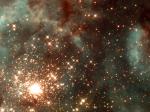 Star Cluster R136 Bursts Out
6.05.2007
In the center of star-forming region 30 Doradus lies a huge cluster of the largest, hottest, most massive stars known. These stars, known as the star cluster R136, and part of the surrounding nebula are captured here in this gorgeous visible-light image from the Hubble Space Telescope.
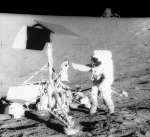 Apollo 12 Visits Surveyor 3
22.10.2018
Apollo 12 was the second mission to land humans on the Moon. The landing site was picked to be near the location of Surveyor 3, a robot spacecraft that had landed on the Moon three years earlier.
 The Heart Nebula in Hydrogen, Oxygen, and Sulfur
27.08.2017
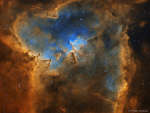
What powers the Heart Nebula? The large emission nebula dubbed IC 1805 looks, in whole, like a heart. The nebula's glow -- as well as the shape of the gas and dust clouds -- is powered by by stellar winds and radiation from massive hot stars in the nebula's newborn star cluster Melotte 15.
 The X-Ray Moon
29.09.1996
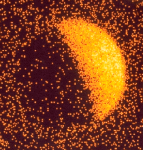
This X-Ray image of the Moon was made by the orbiting Roentgen Observatory Satellite (ROSAT) in 1990. It shows three distinct regions: a bright X-ray sky, a bright part of the Moon, and a relatively dark part of the Moon. The bright X-ray sky is due to the diffuse cosmic X-ray background.
|
January February March April May June July August September October |
|||||||||||||||||||||||||||||||||||||||||||||||||