
|
You entered: image
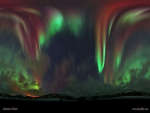 A Full Sky Aurora Over Norway
1.01.2017
Higher than the highest building, higher than the highest mountain, higher than the highest airplane, lies the realm of the aurora. Auroras rarely reach below 60 kilometers, and can range up to 1000 kilometers. Aurora light results from energetic electrons and protons striking molecules in the Earth's atmosphere.
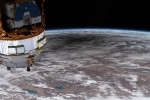 Eclipse under the ISS
27.06.2020
The dark shadow of the New Moon reached out and touched planet Earth on June 21. A high definition camera outside the International Space Station captured its passing in this snapshot from low Earth orbit near the border of Kazakhstan and China.
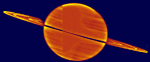 Sunlight Through Saturn's Rings
11.05.1996
Normally, Earth based astronomers view Saturn's spectacular ring system fully illuminated by reflected sunlight. However, this November 1995 Hubble Space Telescope composite image was made to take advantage of an unusual perspective, with the Sun actually illuminating the rings from below.
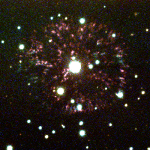 The Firework Nebula
4.07.1998
Imaged by the WIYN Telescope, the Firework Nebula is the result of a type of stellar explosion called a nova. In a nova, a nuclear detonation on the surface of a compact white dwarf star blasts away material that has been dumped on its surface by a companion star.
 Endurance Crater on Mars
10.05.2004
Scroll right to see the inside of Endurance Crater, the large impact feature now being investigated by the Opportunity rover rolling across Mars. The crater's walls show areas of light rock that might hold clues about the ancient watery past of this Martian region.
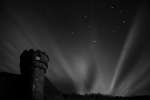 Moon Rays Over Thurso Castle
18.05.2009
What's happening over that castle? While waiting for the Moon to rise last month in Thurso, Scotland, amateur astrophotographer Stewart Watt took a three minute exposure of the background stars. The above image was the surprising result.
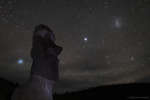 Stars Over Easter Island
12.10.2009
Why were the statues on Easter Island built? No one is sure. What is sure is that over 800 large stone statues exist there. The Easter Island statues, stand, on the average, over twice as tall as a person and have over 200 times as much mass.
 The Iron Moon
1.06.1996
In March and April of 1994 the unmanned Clementine spacecraft demonstrated the technique of prospecting on the Moon from lunar orbit. To accomplish this, Clementine turned an array of cameras sensitive to ultraviolet-visible and near-infrared light toward the lunar surface, producing the first broad-spectrum global imaging of the moon.
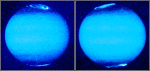 Jupiter's Auroras
18.10.1996
Auroras are especially large on Jupiter. In pictures released yesterday, the Hubble Space Telescope imaged these unusual light displays in more detail than ever before. Jupiter's auroras are linked to its volcanic moon Io.
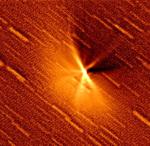 More Jets from Comet Hale-Bopp
13.02.1997
Comets become fountains of gas and dust as they get near the Sun. Solar heat vaporizes the outer layers of these spectacular orbiting icebergs, exposing caverns of pressurized gas that erupt into jets. The above digitally enhanced image of Comet Hale-Bopp was taken on January 29th and highlights several of these dust jets.
|
January February March April May June July August September |
|||||||||||||||||||||||||||||||||||||||||||||||||