
|
You entered: sky
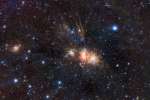 Vista with NGC 2170
15.10.2010
Drifting through the one-horned constellation Monoceros, these dusty streamers and new born stars are part of the active Monoceros R2 star-forming region, embedded in a giant molecular cloud. The cosmic scene was recorded by the VISTA survey telescope in near-infrared light.
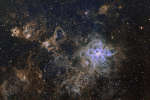 The Cosmic Web of the Tarantula Nebula
11.01.2011
It is the largest and most complex star forming region in the entire galactic neighborhood. Located in the Large Magellanic Cloud, a small satellite galaxy orbiting our Milky Way galaxy, the region's spidery appearance is responsible for its popular name, the Tarantula nebula. This tarantula, however, is about 1,000 light-years across.
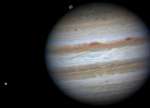 Jupiter Near Opposition
22.10.2011
On October 29 (UT), Jupiter, the solar system's largest planet, will be at opposition, opposite the Sun in planet Earth's sky, shining brightly and rising as the Sun sets. That configuration results...
 The Moon from Zond 8
16.07.2013
Which moon is this? Earth's. Our Moon's unfamiliar appearance is due partly to an unfamiliar viewing angle as captured by a little-known spacecraft -- the Soviet Union's Zond 8 that circled the Moon in October of 1970.
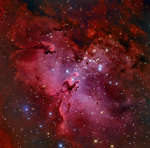 M16 and the Eagle Nebula
7.06.2014
A star cluster around 2 million years young, M16 is surrounded by natal clouds of dust and glowing gas also known as The Eagle Nebula. This beautifully detailed image of the region includes cosmic sculptures made famous in Hubble Space Telescope close-ups of the starforming complex.
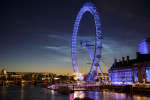 Noctilucent Clouds over London
10.07.2014
This scene from the early morning hours of July 3 looks out across the River Thames from the Westminster Bridge. Part of a luminous timelapse video (vimeo), the frame captures a sight familiar in London, the nighttime glow of the London Eye.
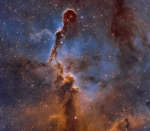 The Elephant s Trunk Nebula in Cepheus
16.08.2019
Like an illustration in a galactic Just So Story, the Elephant's Trunk Nebula winds through the emission nebula and young star cluster complex IC 1396, in the high and far off constellation of Cepheus. Also known as vdB 142, the cosmic elephant's trunk is over 20 light-years long.
 Aurora over Clouds
30.05.2021
Auroras usually occur high above the clouds. The auroral glow is created when fast-moving particles ejected from the Sun impact the Earth's magnetosphere, from which charged particles spiral along the Earth's magnetic field to strike atoms and molecules high in the Earth's atmosphere.
 APOD: 2023 September 3 Б Comet Schwassmann Wachmann 3 Fragments
3.09.2023
Periodic comet 73P/Schwassmann-Wachmann 3 has broken up at least twice. A cosmic souffle of ice and dust left over from the early solar system, this comet was first seen to split into several large pieces during the close-in part of its orbit in 1995.
 APOD: 2024 January 8 Б The Phases of Venus
8.01.2024
Venus goes through phases. Just like our Moon, Venus can appear as a full circular disk, a thin crescent, or anything in between. Venus, frequently the brightest object in the post-sunset or pre-sunrise sky, appears so small, however, that it usually requires binoculars or a small telescope to clearly see its current phase.
|
January February March April May June July August September October |
|||||||||||||||||||||||||||||||||||||||||||||||||