
|
You entered: telescope
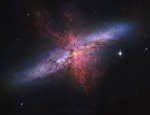 M82: Galaxy with a Supergalactic Wind
23.07.2019
Why is the Cigar Galaxy billowing red smoke? M82, as this starburst galaxy is also known, was stirred up by a recent pass near large spiral galaxy M81. This doesn't fully explain the source of the red-glowing outwardly expanding gas and dust, however.
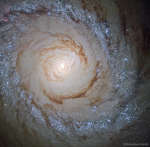 Starburst Galaxy M94 from Hubble
1.12.2019
Why does this galaxy have a ring of bright blue stars? Beautiful island universe Messier 94 lies a mere 15 million light-years distant in the northern constellation of the Hunting Dogs (Canes Venatici).
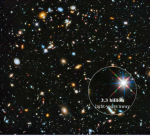 The Hubble Ultra Deep Field in Light and Sound
2.08.2021
Have you heard about the Hubble Ultra-Deep Field? Either way, you've likely not heard about it like this -- please run your cursor over the featured image and listen! The Hubble Ultra-Deep Field (HUDF)...
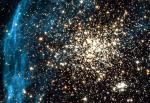 NGC 1850: Not Found in the Milky Way
12.07.2001
A mere 168,000 light-years distant, this large, lovely cluster of stars, NGC 1850, is located near the outskirts of the central bar structure in our neighboring galaxy, the Large Magellanic Cloud. A first...
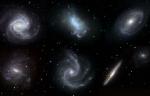 Visitors Galaxy Gallery
18.06.2005
A tantalizing assortment of island universes is assembled here. From top left to bottom right are the lovely but distant galaxies M61, NGC 4449, NGC 4725, NGC 5068, NGC 5247, and NGC 5775/5774. Most are spiral galaxies more or less like our own Milky Way.
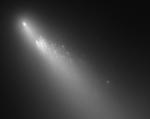 Schwassmann Wachmann 3: Fragment B
4.05.2006
Periodic comet 73P/Schwassmann-Wachmann 3 has fallen apart before. A cosmic souffle of ice and dust left over from the early solar system, this comet was seen to split into several large pieces during the close-in part of its orbit in 1995.
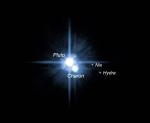 Nix and Hydra
24.06.2006
Discovered in mid-2005, Pluto's small moons were provisionally designated S/2005 P1 and S/2005 P2. They have now been officially christened Nix and Hydra. Compared to Pluto and its large moon Charon...
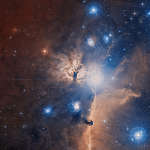 Inside the Flame Nebula
2.11.2019
The Flame Nebula stands out in this optical image of the dusty, crowded star forming regions toward Orion's belt, a mere 1,400 light-years away. X-ray data from the Chandra Observatory and infrared images from the Spitzer Space Telescope can take you inside the glowing gas and obscuring dust clouds though.
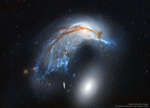 The Porpoise Galaxy from Hubble
10.05.2020
What's happening to this spiral galaxy? Just a few hundred million years ago, NGC 2936, the upper of the two large galaxies shown, was likely a normal spiral galaxy -- spinning, creating stars -- and minding its own business.
 The Southern Cliff in the Lagoon
15.05.2021
Undulating bright ridges and dusty clouds cross this close-up of the nearby star forming region M8, also known as the Lagoon Nebula. A sharp, false-color composite of narrow band visible and broad band near-infrared...
|
January February March April May June July August September October |
|||||||||||||||||||||||||||||||||||||||||||||||||