
|
You entered: stars
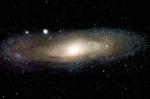 Andromeda Island Universe
8.09.2000
How far can you see? The most distant object easily visible to the unaided eye is M31, the great Andromeda Galaxy some two million light-years away. Without a telescope, even this immense spiral galaxy appears as an unremarkable, faint, nebulous cloud in the constellation Andromeda
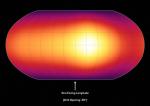 HD 189733b: Hot Jupiter
12.05.2007
HD 189733b is a Jupiter-sized planet known to orbit a star some 63 light-years away. But while the distant world is approximately the size of Jupiter, its close-in orbit makes it much hotter than our solar system's ruling gas giant.
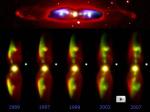 Monitoring M2-9
18.06.2007
Exploring the myriad shapes found in the cosmic zoo of planetary nebulae, some astronomers have focused on the intriguing example of M2-9. About 2,100 light-years away and over one light-year across, M2-9 is known as a twin jet or butterfly nebula in reference to its striking bipolar symmetry.
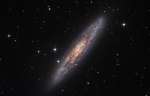 NGC 253: Dusty Island Universe
26.07.2014
Shiny NGC 253 is one of the brightest spiral galaxies visible, and also one of the dustiest. Some call it the Silver Dollar Galaxy for its appearance in small telescopes, or just the Sculptor Galaxy for its location within the boundaries of the southern constellation Sculptor.
 NGC 7635: The Bubble Nebula
22.04.2016
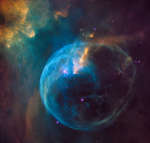
Blown by the wind from a massive star, this interstellar apparition has a surprisingly familiar shape. Cataloged as NGC 7635, it is also known simply as The Bubble Nebula. Although it looks delicate, the 7 light-year diameter bubble offers evidence of violent processes at work.
 Firing Lasers to Tame the Sky
10.02.2021
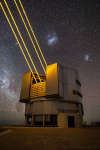
Why do stars twinkle? Our atmosphere is to blame as pockets of slightly off-temperature air, in constant motion, distort the light paths from distant astronomical objects. Atmospheric turbulence is a problem for astronomers because it blurs the images of the sources they want to study.
 Planetary Nebula Abell 7
21.05.2022
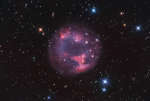
Very faint planetary nebula Abell 7 is some 1,800 light-years distant, just south of Orion in planet Earth's skies in the constellation Lepus, The Hare. Surrounded by Milky Way stars and near...
 Comet Halley and the Milky Way
3.10.1997
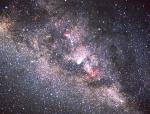
Comet Halley was photographed superposed in front of the disk of our Milky Way Galaxy in 1986 by the Kuiper Airborne Observatory. Comet Halley is the bright white streak near this photograph's center. Comet Halley is the most famous comet in history, and returns to the inner Solar System every 76 years.
 Comet SOHO and Nebulae in Orion
4.06.1998
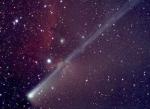
Astrophotographer Michael Horn captured this gorgeous view of comet SOHO in the dark night sky above Wandibindle, Queensland, Australia on May 23rd. On this date, comet SOHO was moving against the background of the nebula-rich constellation of Orion.
 Venus on the Horizon
19.06.1999
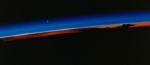
Venus can appear as a brilliant evening star. Besides the sun and moon, Venus is the brightest object visible in Earth's sky. Because it is closer to the sun than Earth, Venus never...
|
January February March April May June July August September October |
|||||||||||||||||||||||||||||||||||||||||||||||||