
|
You entered: Galactic Center
 NGC 1893 and the Tadpoles of IC 410
2.02.2024
This cosmic view shows off an otherwise faint emission nebula IC 410, captured under clear Netherlands skies with telescope and narrowband filters. Above and right of center you can spot two remarkable inhabitants of the interstellar pond of gas and dust, known as the tadpoles of IC 410.
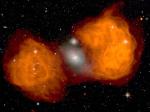 The Giant Radio Lobes of Fornax A
28.06.2005
Together, the radio lobes span over one million light years -- what caused them? In the center is a large but peculiar elliptical galaxy dubbed NGC 1316. Detailed inspection of the NGC 1316 system indicates that it began absorbing a small neighboring galaxy about 100 million years ago.
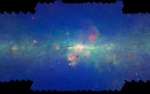 Spitzer s Milky Way
5.06.2008
The Spitzer Space Telescope's encompasing infrared view of the plane of our Milky Way Galaxy is hard to appreciate in just one picture. In fact, more than 800,000 frames of data from...
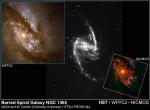 NGC 1365: Barred Spiral Galaxy
8.10.1999
NGC 1365 is a giant barred spiral galaxy about 200,000 light-years in diameter and 60 million light-years distant in the southern constellation Fornax. These three recently released images offer views of this majestic island universe in visible and infrared light.
 Great Orion Nebulae
13.09.2011
The Great Nebula in Orion, also known as M42, is one of the most famous nebulas in the sky. The star forming region's glowing gas clouds and hot young stars...
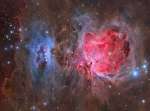 Great Orion Nebulae
23.10.2008
The Great Nebula in Orion, also known as M42, is one of the most famous nebulae in the sky. The star forming region's glowing gas clouds and hot young stars...
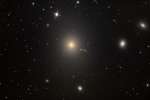 M87: Elliptical Galaxy with Jet
20.05.2010
In spiral galaxies, majestic winding arms of young stars, gas, and dust rotate in a flat disk around a bulging galactic nucleus. But elliptical galaxies seem to be simpler. Lacking gas and dust to form new stars, their randomly swarming older stars, give them an ellipsoidal (egg-like) shape. Still, elliptical galaxies can be very large.
 Spiral Galaxy NGC 2841
23.03.2023
A mere 46 million light-years distant, spiral galaxy NGC 2841 can be found in planet Earth's night sky toward the northern constellation of Ursa Major. This sharp image centered on the gorgeous island universe also captures spiky foreground Milky Way stars and more distant background galaxies within the same telescopic field of view.
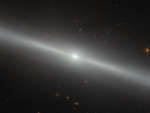 NGC 4762: A Galaxy on the Edge
4.11.2014
Why is there a bright line on the sky? What is pictured above is actually a disk galaxy being seen almost perfectly edge on. The image from the Hubble Space Telescope is a spectacular visual reminder of just how thin disk galaxies can be.
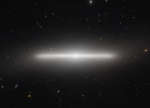 NGC 4452: An Extremely Thin Galaxy
9.11.2010
Why is there a line segment on the sky? In one of the more precise alignments known in the universe, what is pictured above is actually a disk galaxy being seen almost perfectly edge on. The image from the Hubble Space Telescope is a spectacular visual reminder of just how thin disk galaxies can be.
|
January February March April May June July August September October |
|||||||||||||||||||||||||||||||||||||||||||||||||