
|
You entered: Milky Way
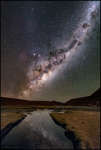 The Altiplano Night
7.07.2016
The Milky Way is massively bright on this cold, clear, altiplano night. At 4,500 meters its reflection in a river, a volcanic peak on the distant horizon, is captured in this stitched panorama under naturally dark skies of the northern Chilean highlands near San Pedro de Atacama.
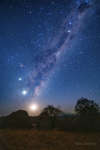 Moon, Four Planets, and Emu
8.02.2019
A luminous Milky Way falls toward the horizon in this deep skyscape, starting at the top of the frame from the stars of the Southern Cross and the dark Coalsack Nebula. Captured...
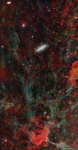 The Deep Sky Toward Andromeda
8.09.2021
What surrounds the Andromeda galaxy? Out in space, Andromeda (M31) is closely surrounded by several small satellite galaxies, and further out it is part of the Local Group of Galaxies -- of which our Milky Way galaxy is also a member.
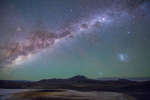 Galaxies from the Altiplano
13.10.2016
The central bulge of our Milky Way Galaxy rises over the northern Chilean Atacama altiplano in this postcard from planet Earth. At an altitude of 4500 meters, the strange beauty of the desolate landscape could almost belong to another world though.
 Rubin s Galaxy
25.01.2020
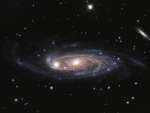
In this Hubble Space Telescope image the bright, spiky stars lie in the foreground toward the heroic northern constellation Perseus and well within our own Milky Way galaxy. In sharp focus beyond is UGC 2885, a giant spiral galaxy about 232 million light-years distant.
 The View Toward M101
4.05.2018
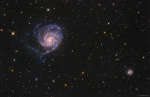
Big, beautiful spiral galaxy M101 is one of the last entries in Charles Messier's famous catalog, but definitely not one of the least. About 170,000 light-years across, this galaxy is enormous, almost twice the size of our own Milky Way galaxy.
 At the Center of the Milk Way
18.10.2002
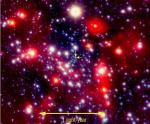
At the center of our Milky Way Galaxy lies a black hole with over 2 million times the mass of the Sun. Once a controversial claim, this astounding conclusion is now virtually inescapable and based on observations of stars orbiting very near the galactic center.
 M31: The Andromeda Galaxy
9.09.2019
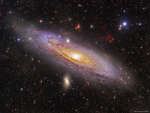
How far can you see? The most distant object easily visible to the unaided eye is M31, the great Andromeda Galaxy, over two million light-years away. Without a telescope, even this immense spiral galaxy appears as an unremarkable, faint, nebulous cloud in the constellation Andromeda.
 Regulus and the Dwarf Galaxy
26.04.2024
In northern hemisphere spring, bright star Regulus is easy to spot above the eastern horizon. The alpha star of the constellation Leo, Regulus is the spiky star centered in this telescopic field of view.
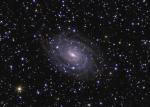 NGC 6384: Beyond the Stars
12.07.2007
The universe is filled with galaxies. But to see them astronomers must look out beyond the stars of our galaxy, the Milky Way. For example, consider this colorful telescopic view of spiral galaxy NGC 6384, about 80 million light-years away in the direction of the constellation Ophiuchus.
|
January February March April May June July August September October |
|||||||||||||||||||||||||||||||||||||||||||||||||