
|
You entered: dust disk
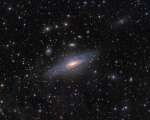 NGC 7331 and Beyond
12.08.2011
Big, beautiful spiral galaxy NGC 7331 is often touted as an analog to our own Milky Way. About 50 million light-years distant in the northern constellation Pegasus, NGC 7331 was recognized early on as a spiral nebula and is actually one of the brighter galaxies not included in Charles Messier's famous 18th century catalog.
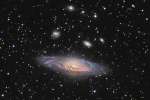 NGC 7331 and Beyond
1.03.2014
Big, beautiful spiral galaxy NGC 7331 is often touted as an analog to our own Milky Way. About 50 million light-years distant in the northern constellation Pegasus, NGC 7331 was recognized early on as a spiral nebula and is actually one of the brighter galaxies not included in Charles Messier's famous 18th century catalog.
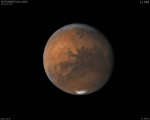 Solis Lacus: The Eye of Mars
1.10.2020
As telescopes around planet Earth watch, Mars is growing brighter in night skies, approaching its 2020 opposition on October 13. Mars looks like its watching too in this view of the Red Planet from September 22.
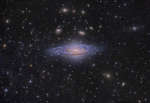 NGC 7331 and Beyond
17.12.2014
Big, beautiful spiral galaxy NGC 7331 is often touted as an analog to our own Milky Way. About 50 million light-years distant in the northern constellation Pegasus, NGC 7331 was recognized early on as a spiral nebula and is actually one of the brighter galaxies not included in Charles Messier's famous 18th century catalog.
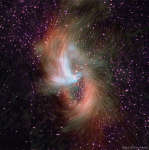 Our Galaxys Magnetic Center
19.06.2019
What's the magnetic field like in the center of our Milky Way Galaxy? To help find out, NASA's SOFIA -- an observatory flying in a modified 747 -- imaged the central region with...
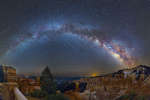 Meteors, Planes, and a Galaxy over Bryce Canyon
19.05.2014
Sometimes land and sky are both busy and beautiful. The landscape pictured in the foreground encompasses Bryce Canyon in Utah, USA, famous for its many interesting rock structures eroded over millions of years.
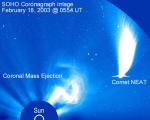 Comet NEAT Passes an Erupting Sun
24.02.2003
As Comet NEAT flared last week, the Sun roared. Just as the comet swooped inside the orbit of Mercury and developed a long and flowing tail of gas and dust, the Sun emitted a huge Coronal Mass Ejection (CME).
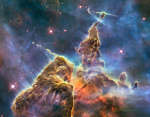 Dust Pillar of the Carina Nebula
26.04.2010
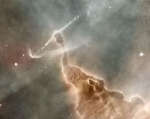
Inside the head of this interstellar monster is a star that is slowly destroying it. The monster, on the right, is actually an inanimate pillar of gas and dust that measures over a light year in length.
 Dust Pillar of the Carina Nebula
24.03.2013
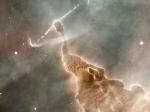
Inside the head of this interstellar monster is a star that is slowly destroying it. The monster, actually an inanimate pillar of gas and dust, measures over a light year in length. The star, not itself visible through the opaque dust, is bursting out partly by ejecting energetic beams of particles.
 Dust Pillars of the Carina Nebula
30.04.2007
Inside the head of this interstellar monster is a star that is slowly destroying it. The monster, actually an inanimate pillar of gas and dust, measures over a light year in length. The star, not itself visible through the opaque dust, is bursting out partly by ejecting energetic beams of particles.
|
January February March April May June July August |
||||||||||||||||||||||||||||||||||||||||||||||||||||||||