
|
You entered: full moon
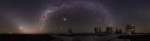 Wonder and Mystery above the Very Large Telescopes
9.05.2011
What's that bright orange dot above the large telescope on the right? Even seasoned sky enthusiasts might ponder the origin of the orange orb seen by scrolling across this panoramic image, taken last December. Perhaps identifying known objects will help.
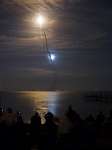 Endeavour in the Moon
20.11.2008
Glaring near the top of the frame, the shuttle orbiter Endeavour rockets into the night on the STS-126 mission. Endeavour left planet Earth on November 14 from Launch Pad 39A at NASA's Kennedy Space Center, making the 27th flight to the International Space Station.
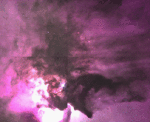 A Close-Up of the Lagoon Nebula
20.08.1996
Ribbons of red-glowing gas and dark dust surround massive young stars in this close-up of the Lagoon Nebula taken by the Hubble Space Telescope. The Lagoon Nebula is relatively close and bright - it appears larger than the Full Moon and is visible even without a telescope.
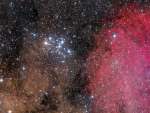 M6: The Butterfly Cluster
3.09.2014
To some, the outline of the open cluster of stars M6 resembles a butterfly. M6, also known as NGC 6405, spans about 20 light-years and lies about 2,000 light years distant. M6, pictured...
 Meteors vs Supermoon
16.12.2016
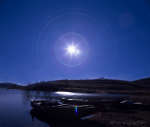
Geminid meteors battled supermoonlight in planet Earth's night skies on December 13/14. Traveling at 35 kilometers (22 miles) per second, the bits of dust from the mysterious asteroid 3200 Phaethon that produce the meteor streaks are faster than a speeding bullet.
 APOD: 2025 July 23 Б Fireball over Cape San Blas
23.07.2025
Have you ever seen a fireball? In astronomy, a fireball is a very bright meteor -- one at least as bright as Venus and possibly brighter than even a full Moon. Fireballs are rare -- if you see one you are likely to remember it for your whole life.
 Harvest Moon Eclipse
23.09.2016
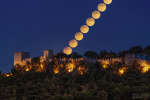
A Harvest Moon rises over Sesimbra Castle south of Lisbon in this impressive series of telephoto exposures. Captured at its full phase, the golden Moon was also gliding through the Earth's more diffuse outer shadow during September's penumbral lunar eclipse. The eclipse shading is subtle compared to a total lunar eclipse.
 A Leonid Bolide Over Kansas
25.11.1998
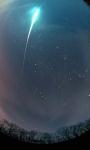
The 1998 Leonid Meteor Shower featured many bright events. Extremely bright meteors, known as bolides or fireballs, can briefly glow brighter than the full moon. Pictured above is a Leonid bolide caught during a five-minute, wide-angle exposure. The bolide was so bright it lit up the surrounding area, making otherwise dark trees visible.
 The Heart Nebula in Hydrogen, Oxygen, and Sulfur
27.08.2017
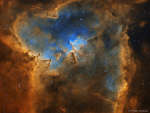
What powers the Heart Nebula? The large emission nebula dubbed IC 1805 looks, in whole, like a heart. The nebula's glow -- as well as the shape of the gas and dust clouds -- is powered by by stellar winds and radiation from massive hot stars in the nebula's newborn star cluster Melotte 15.
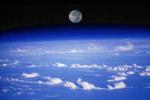 Moonset, Planet Earth
21.09.2002
During the Astro-1 astronomy mission of December, 1990, Space Shuttle astronauts photographed this stunning view of the setting full moon poised above the Earth's limb. In the foreground, towering clouds of condensing water vapor mark the extent of the troposphere, the lowest layer of the planet's life-sustaining atmosphere.
|
January February March April May June July August September October |
|||||||||||||||||||||||||||||||||||||||||||||||||