
|
You entered: supernova remnant
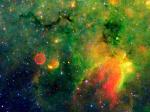 A Galactic Star Forming Region in Infrared
24.09.2007
How do stars form? To help study this complex issue, astronomers took a deep image in infrared light of an active part of our Milky Way Galaxy where star formation is rampant. In IRDC G11.11-0
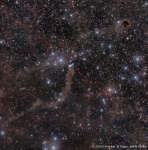 In Wolf s Cave
7.09.2019
The mysterious blue reflection nebula found in catalogs as VdB 152 or Ced 201 really is very faint. It lies at the tip of the long dark nebula Barnard 175 in a dusty complex that has also been called Wolf's Cave.
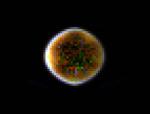 Gamma Ray Earth
31.03.2005
The pixelated planet above is actually our own planet Earth seen in gamma rays - the most energetic form of light. In fact, the gamma rays used to construct this view pack over 35 million electron volts (MeV) compared to a mere two electron volts (eV) for a typical visible light photon.
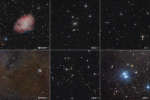 Catalog Entry Number 1
15.03.2018
Every journey has first step and every catalog a first entry. First entries in six well-known deep sky catalogs appear in these panels, from upper left to lower right in chronological order of original catalog publication.
 A Lunar Eclipse on Solstice Day
20.12.2010
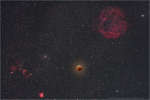
Sometime after sunset tonight, the Moon will go dark. This total lunar eclipse, where the entire Moon is engulfed in the shadow of the Earth, will be visible from all of North America, while the partial phase of this eclipse will be visible throughout much of the rest of the world.
 Recycling Cassiopeia A
28.12.2017
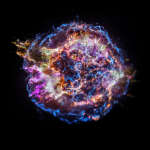
Massive stars in our Milky Way Galaxy live spectacular lives. Collapsing from vast cosmic clouds, their nuclear furnaces ignite and create heavy elements in their cores. After a few million years, the enriched material is blasted back into interstellar space where star formation can begin anew.
 Star Trails and the Bracewell Radio Sundial
13.07.2018
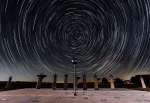
Sundials use the location of a shadow to measure the Earth's rotation and indicate the time of day. So it's fitting that this sundial, at the Very Large Array Radio Telescope Observatory in New Mexico, commemorates the history of radio astronomy and radio astronomy pioneer Ronald Bracewell.
 X-Ray Ring Around SN1987A
12.05.2000
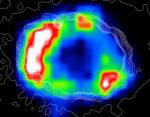
This false-color image from the Chandra X-ray Observatory reveals a one light-year diameter ring of hot, ten million degree plasma. It is one of the most detailed X-ray images of the expanding blast wave from supernova 1987A (SN1987A).
 In the Glare of Alpha Centauri
28.06.2012
The glare of Alpha Centauri, one of the brightest stars in planet Earth's night sky, floods the left side of this southern skyscape. A mere 4.3 light-years distant, Alpha Centauri actually consists of two component stars similar in size to the Sun, locked in a mutual orbit.
 Fermi Catalogs the Gamma ray Sky
18.03.2010
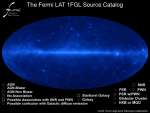
What shines in the gamma-ray sky? The most complete answer yet to that question is offered by the Fermi Gamma-ray Space Telescope's first all-sky catalog. Fermi's sources of cosmic gamma-rays feature nature...
|
January February March April May June July August September October |
|||||||||||||||||||||||||||||||||||||||||||||||||