
|
You entered: Moon
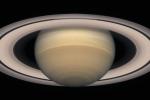 Saturn: Lord of the Rings
15.02.2002
Born on today's date in 1564, Galileo used a telescope to explore the Solar System. In 1610, he became the first to be amazed by Saturn's rings. After nearly 400 years, Saturn's magnificent rings still offer one of the most stunning astronomical sights.
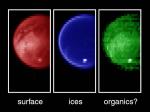 Titan from Cassini in Infrared
6.07.2004
Could life exist under the smog of Titan? If not, what is creating all of the methane? To help answer these questions, the largest and most mysterious moon of Saturn got a quick first look from the Cassini robot spacecraft soon after entering orbit around the giant planet last week.
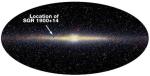 Magnetar In The Sky
2.10.1998
Indicated on this infrared image of the galactic center region is the position of SGR 1900+14 - the strongest known magnet in the galaxy. SGR 1900+14 is believed to be a city-sized, spinning, super-magnetic neutron star, or Magnetar. How strong is a Magnetar's magnetic field?
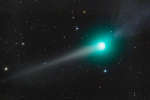 Two Tails of Comet Lulin
25.02.2009
Go outside tonight and see Comet Lulin. From a dark location, you should need only a good star map and admirable perseverance -- although wide-field binoculars might help. Yesterday, Comet Lulin passed its closest to Earth, so that the comet will remain near its brightest over the next few days.
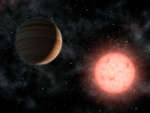 VB 10: A Large Planet Orbiting a Small Star
3.06.2009
Can a planet be as large as the star that it orbits? Recent observations have discovered that nearby Van Biesbroeck's star might have just such a large planet. Although VB 10 lies only...
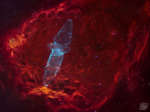 Ou4: A Giant Squid in a Flying Bat
7.10.2020
A very faint but very large squid-like nebula is visible in planet Earth's sky -- but inside a still larger bat. The Giant Squid Nebula cataloged as Ou4, and Sh2-129 also known as the Flying Bat Nebula, are both caught in this cosmic scene toward the royal royal constellation Cepheus.
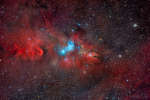 Fox Fur, Unicorn, and Christmas Tree
26.12.2020
Clouds of glowing hydrogen gas fill this colorful skyscape in the faint but fanciful constellation Monoceros, the Unicorn. A star forming region cataloged as NGC 2264, the complex jumble of cosmic gas and dust...
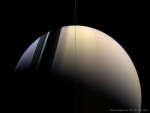 Saturn in Blue and Gold
29.08.2017
Why is Saturn partly blue? The featured picture of Saturn approximates what a human would see if hovering close to the giant ringed world. The image was taken in 2006 March by the robot Cassini spacecraft now orbiting Saturn. Here Saturn's majestic rings appear directly only as a thin vertical line.
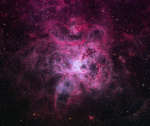 The Tarantula Nebula
17.11.2018
The Tarantula Nebula, also known as 30 Doradus, is more than a thousand light-years in diameter, a giant star forming region within nearby satellite galaxy the Large Magellanic Cloud. About 180 thousand light-years away, it's the largest, most violent star forming region known in the whole Local Group of galaxies.
 APOD: 2025 April 14 Б The Galactic Center in Radio from MeerKAT
14.04.2025
What's happening at the center of our galaxy? It's hard to tell with optical telescopes since visible light is blocked by intervening interstellar dust. In other bands of light, though, such as radio, the galactic center can be imaged and shows itself to be quite an interesting and active place.
|
January February March April May June July August September October |
|||||||||||||||||||||||||||||||||||||||||||||||||