
|
You entered: sky
 IC 348 and Barnard 3
14.11.2024
A great nebulous region near bright star omicron Persei offers this study in cosmic contrasts. Captured in the telescopic frame the colorful complex of dust, gas, and stars spans about 3 degrees on the sky along the edge of the Perseus molecular cloud some 1000 light-years away.
 APOD: 2025 September 26 Б A SWAN an ATLAS and Mars
26.09.2025
A new visitor to the inner Solar System, comet C/2025 R2 (SWAN) sports a long ion tail extending diagonally across this almost 7 degree wide telescopic field of view recorded on September 21.
 APOD: 2026 September 28 Б Cosmic Latte: The Average Color of the Universe
28.09.2026
What color is the universe? More precisely, if the entire sky were smeared out, what color would the final mix be? This whimsical question came up when trying to determine what stars are commonplace in nearby galaxies. The answer, depicted here, is a conditionally perceived shade of beige. In computer parlance: #FFF8E7.
 Mercury on the Horizon
12.04.2003
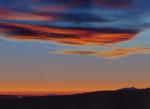
Have you ever seen the planet Mercury? Because Mercury orbits so close to the Sun, it never wanders far from the Sun in Earth's sky. If trailing the Sun, Mercury will be visible low on the horizon for only a short while before sunset.
 Comet Hale-Bopp Over Val Parola Pass
17.03.1997
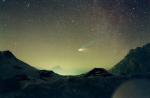
Comet Hale-Bopp is now much brighter than any surrounding stars. It can be seen even over bright city lights. Out away from city lights, however, it is putting on quite a spectacular show. Here Comet Hale-Bopp was photographed last week above Val Parola Pass in the Dolomite mountains surrounding Cortina d'Ampezzo, Italy.
 Cygnus Nebulosities
23.10.2003
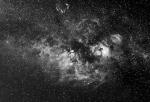
Looking toward the constellation Cygnus, a stunning and complex region of nebulae strewn along the plane of our Milky Way galaxy is revealed in this unique wide-angle sky view. Recorded with a filter designed...
 Solstice Celebration
20.06.2004
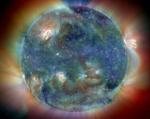
Season's greetings! Today or tomorrow, depending on your time zone, the Sun reaches its northernmost point in planet Earth's sky marking a season change and the first solstice of the year 2004. In celebration, consider this delightfully detailed, brightly colored image of the active Sun.
 Tempel Tuttle: The Leonid Comet
13.11.1999
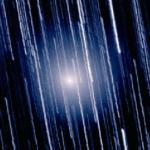
Star trails streak this composite time exposure of Comet Tempel-Tuttle recorded by T. Puckett on January 26, 1998. Then passing through the inner solar system on its 33 year orbit around the Sun, Tempel-Tuttle brightened unexpectedly, but binoculars or small telescopes were still required to visually observe it.
 NGC 7023: The Iris Nebula
12.11.2010
Like delicate cosmic petals, these clouds of interstellar dust and gas have blossomed 1,300 light-years away in the fertile star fields of the constellation Cepheus. Sometimes called the Iris Nebula and dutifully cataloged as NGC 7023, this is not the only nebula in the sky to evoke the imagery of flowers.
 Atlantis Farewell from Parkes
21.07.2011
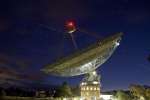
The Parkes 64 meter radio telescope is known for its contribution to human spaceflight, famously supplying television images from the Moon to denizens of planet Earth during Apollo 11. The enormous, steerable, single dish looms in the foreground of this early evening skyscape.
|
January February March April May June July August September October |
|||||||||||||||||||||||||||||||||||||||||||||||||