
|
You entered: planets
 A Beautiful Trifid
3.07.2024
The beautiful Trifid Nebula is a cosmic study in contrasts. Also known as M20, it lies about 5,000 light-years away toward the nebula rich constellation Sagittarius. A star forming region in the plane...
 Eclipse Pair
2.01.2025
Eclipses tend to come in pairs. Twice a year, during an eclipse season that lasts about 34 days, Sun, Moon, and Earth can nearly align. Then the full and new phases of the Moon, separated by just over 14 days, create a lunar and a solar eclipse.
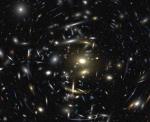 Simulated Galaxy Cluster View
5.03.2002
Stunningly detailed, this picture is a computer simulated view of a cluster of galaxies in the distant cosmos. A large, elliptical galaxy dominates this hypothetical cluster's central region surrounded by a swarm of member galaxies.
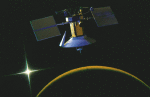 A World Explorer
25.08.1995
Ferdinand Magellan was a world explorer. Many consider him the greatest navigator of Europe's 16th century age of sea going exploration and credit his expedition with the first circumnavigation of planet Earth. NASA...
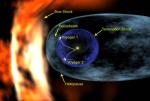 Voyager at 90 AU
19.11.2003
Launched in 1977, Voyager 1 is now about 12 light-hours or 90 astronomical units (AU) from the Sun, making this spacecraft humanity's most distant ambassador to the cosmos. Well beyond the orbits...
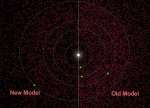 Asteroids Near Earth
1.10.2011
Though the sizes are not to scale, the Sun and planets of the inner solar system are shown in this illustration, where each red dot represents an asteroid. New results from NEOWISE, the infrared...
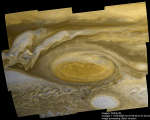 Jupiters Great Red Spot from Voyager 1
18.05.2014
What will become of Jupiter's Great Red Spot? Recorded as shrinking since the 1930s, the rate of the Great Red Spot's size appears to have accelerated just in the past few years. A hurricane larger than Earth, the Great Red Spot has been raging at least as long as telescopes could see it.
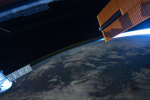 A Perseid Below
10.08.2014
Denizens of planet Earth typically watch meteor showers by looking up. But this remarkable view, captured on August 13, 2011 by astronaut Ron Garan, caught a Perseid meteor by looking down. From Garan...
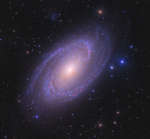 Bright Spiral Galaxy M81
16.10.2015
One of the brightest galaxies in planet Earth's sky is similar in size to our Milky Way Galaxy: big, beautiful M81. The grand spiral galaxy can be found toward the northern constellation of the Great Bear (Ursa Major).
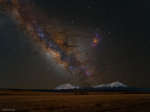 Milky Way Over the Spanish Peaks
23.05.2016
That's not lightning, and it did not strike between those mountains. The diagonal band is actually the central band of our Milky Way Galaxy, while the twin peaks are actually called the Spanish Peaks -- but located in Colorado, USA.
|
January February March April May June July August September October |
|||||||||||||||||||||||||||||||||||||||||||||||||