
|
You entered: star
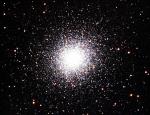 M13: The Great Globular Cluster in Hercules
1.03.2000
M13 is one of the most prominent and best known globular clusters. Visible with binoculars in the constellation of Hercules, M13 is frequently one of the first objects found by curious sky gazers seeking celestials wonders beyond normal human vision.
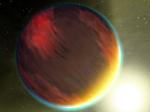 Atmospheres Detected on Two Extrasolar Planets
27.02.2007
Do extrasolar planets have water? In an attempt to find out, the orbiting Spitzer Space Telescope made detailed observations of the atmospheres of two planets that orbit stars other than our Sun. Unfortunately, water vapor was not detected in either exoplanet.
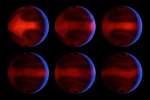 A Dangerous Summer on HD 80606b
4.02.2009
On the distant planet HD 80606b, summers might be dangerous. Hypothetic life forms floating in HD 080606b's atmosphere or lurking on one of its (presently hypothetical) moons might fear the 1,500 Kelvin summer heat, which is hot enough not only to melt lead but also nickel.
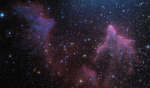 IC 59 and IC 63 in Cassiopeia
3.11.2011
These bright rims and flowing shapes suggest to some melting ice cream on a cosmic scale. Looking toward the constellation Cassiopeia, the colorful (zoomable) skyscape features the swept back, comet-shaped clouds IC 59 (left) and IC 63.
 Our Rotating Earth
1.07.2020
Has your world ever turned upside-down? It would happen every day if you stay fixed to the stars. Most time-lapse videos of the night sky show the stars and sky moving above a steady Earth.
 APOD: 2026 March 30 Б Peculiar Elliptical Galaxy Centaurus A
30.03.2026
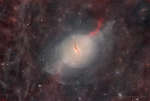
What's happened to the center of this galaxy? Dramatic dust lanes run across the center of unusual elliptical galaxy Centaurus A. These dust lanes are so thick they almost completely obscure the galaxy's center in visible light.
 NGC 7023: The Iris Nebula
4.11.2004
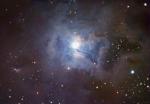
Like delicate cosmic petals, these clouds of interstellar dust and gas have blossomed 1,300 light-years away in the fertile star fields of the constellation Cepheus. Sometimes called the Iris Nebula and dutifully cataloged as NGC 7023, this is not the only nebula in the sky to evoke the imagery of flowers.
 I Zwicky 18: Young Galaxy
3.12.2004
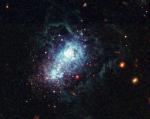
The Milky Way is an ordinary 12 billion year old spiral galaxy, and even our middle-aged Sun is pushing 4.5 billion years. But all the stars in dwarf galaxy I Zwicky 18 are much younger.
 Smoke from the Cigar Galaxy
14.04.2006
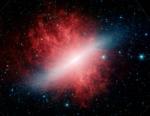
Very bright in infrared light, well-known starburst galaxy M82's popular name describes its suggestive shape seen at visible wavelengths - The Cigar Galaxy. Ironically, M82's fantastic appearance in this Spitzer Space Telescope image...
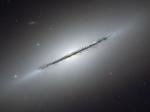 Edge On Galaxy NGC 5866
12.06.2006
Why is this galaxy so thin? Many disk galaxies are actually just as thin as NGC 5866, pictured above, but are not seen edge-on from our vantage point. One galaxy that is situated edge-on is our own Milky Way Galaxy.
|
January February March April May June July August September October |
|||||||||||||||||||||||||||||||||||||||||||||||||