
|
You entered: ring
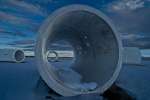 Through a Sun Tunnel
22.12.2011
Today the Sun stands still at 05:30 UT. Halting its steady march toward southern declinations and begining its annual journey north, the event is known as a solstice. In the northern hemisphere December's solstice marks the astronomical start of winter.
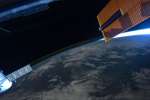 Perseid Below
10.08.2012
Denizens of planet Earth watched last year's Perseid meteor shower by looking up into the bright moonlit night sky. But this remarkable view captured on August 13, 2011 by astronaut Ron Garan looks down on a Perseid meteor.
 Hyades for the Holidays
24.12.2012
Recognized since antiquity and depicted on the shield of Achilles according to Homer, stars of the Hyades cluster form the head of the constellation Taurus the Bull. Their general V-shape is anchored by Aldebaran, the eye of the Bull and by far the constellation's brightest star.
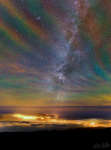 Rainbow Airglow over the Azores
22.03.2016
Why would the sky glow like a giant repeating rainbow? Airglow. Now air glows all of the time, but it is usually hard to see. A disturbance however -- like an approaching storm -- may cause noticeable rippling in the Earth's atmosphere.
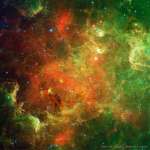 The North America Nebula in Infrared
28.07.2019
The North America Nebula can do what most North Americans cannot -- form stars. Precisely where in the nebula these stars are forming has been mostly obscured by some of the nebula's thick dust that is opaque to visible light.
 APOD: 2025 April 27 Б IC 418: The Spirograph Nebula
27.04.2025
What is creating the strange texture of IC 418? Dubbed the Spirograph Nebula for its resemblance to drawings from a cyclical drawing tool, planetary nebula IC 418 shows patterns that are not well understood. Perhaps they are related to chaotic winds from the variable central star, which changes brightness unpredictably in just a few hours.
 APOD: 2026 May 13 Б NGC 188: Old Cluster in the New General Catalog
13.05.2026
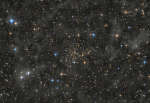
The New General Catalog of star clusters and nebulae really isn't so new. In fact, it was published in 1888 - an effort by J. L. E. Dreyer to consolidate the work of astronomers William, Caroline, and John Herschel along with others into a useful single, complete catalog of astronomical discoveries and measurements.
 X Ray Mystery in RCW 38
27.12.2002
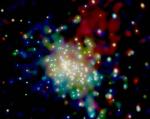
A mere 6,000 light-years distant and sailing through the constellation Vela, star cluster RCW 38 is full of powerful stars. It's no surprise that these stars, only a million years young with hot outer atmospheres, appear as point-like x-ray sources dotting this x-ray image from the orbiting Chandra Observatory.
 Fireball Over Edmonton
25.11.2008
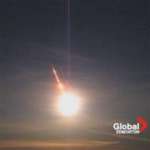
What if you're driving down the street and an object from space shoots across the sky right in front of you? Such was the case last week for many people in south central Canada.
 HUDF Infrared: Dawn of the Galaxies
9.12.2009
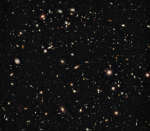
When did galaxies form? To help find out, the deepest near-infrared image of the sky ever has been taken of the same field as the optical-light Hubble Ultra Deep Field (HUDF) in 2004. The new image was taken this summer by the newly installed Wide Field Camera 3 on the refurbished Hubble Space Telescope.
|
January February March April May June July August September October |
|||||||||||||||||||||||||||||||||||||||||||||||||