
|
You entered: GRB
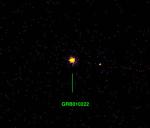 GRB010222: Gamma Ray Burst, X Ray Afterglow
13.04.2001
A fading afterglow from one of the most powerful explosions in the universe is centered in this false color image from the spacebased Chandra X-ray Observatory. The cosmic explosion, an enormously bright gamma-ray burst (GRB), originated in a galaxy billions of light-years away and was detected by the BeppoSAX satellite on February 22.
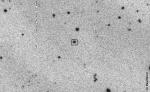 Optical Transient Near GRB970508 Shows Distant Redshift
13.05.1997
The GRB distance scale controversy may have just ended with a flash. Gamma Ray Bursts (GRBs) are powerful explosions occurring in seemingly random positions on the sky. They are so featureless and so poorly resolved, however, that their distances could not be determined.
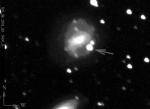 A Gamma Ray Burst Supernova
8.05.1998
Did a gamma-ray burst precede this supernova? This intriguing suggestion came to light yesterday with the discovery of an evolving supernova that is potentially coincident with the position of gamma-ray burst GRB 980425, which occurred just two weeks ago. If true, this would tie together the two most violent phenomena known in the universe.
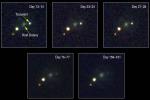 Gamma Ray Burst, Supernova Bump
17.05.2002
On the 21st of November 2001, satellites detected yet another burst of gamma-rays from the cosmos. While this flash of high-energy photons lasted for less than a minute, eager astronomers have been following the fading optical light from the location of the burst source ever since.
 Earendel: A Star in the Early Universe
6.04.2022
Is Earendel the farthest star yet discovered? This scientific possibility started when the Hubble Space Telescope observed a huge cluster of galaxies. The gravitational lens effectбof this cluster was seen to magnify and distort a galaxy far in the background.
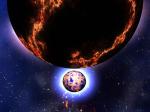 Short Gamma Ray Bursts Localized
17.10.2005
What causes gamma-ray bursts? The most energetic type of explosions known in the cosmos has been an enigma since discovered over 30 years ago. It now appears that there may not be one unique type of progenitor.
 WR 104: A Pinwheel Star System
3.06.2014
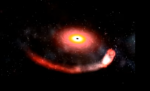
Might this giant pinwheel one-day destroy us? Probably not, but investigation of the unusual star system Wolf-Rayet 104 has turned up an unexpected threat. The unusual pinwheel pattern has been found to be created by energetic winds of gas and dust that are expelled and intertwine as two massive stars orbit each other.
 Unusual Signal Suggests Neutron Star Destroyed by Black Hole
3.09.2019
What created this unusual explosion? Three weeks ago, gravitational wave detectors in the USA and Europe -- the LIGO and Virgo detectors -- detected a burst of gravitational radiation that had the oscillating pattern expected when a black hole destroys a neutron star.
 Gamma-Ray Burst: A Milestone Explosion
2.07.1997
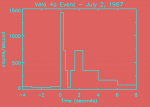
Gamma-Ray Bursts (GRBs) were discovered by accident. In fact, GRBs always seem to be where scientists least expect them. Thirty years ago today, satellites first recorded a GRB. The burst data plotted in this histogram show that the count rate of the gamma-ray instrument abruptly jumped indicating a sudden flash of gamma-rays.
 The Host Galaxies of Long Duration GRBs
17.05.2006
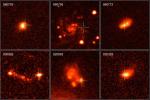
What causes the powerful explosions knows as gamma-ray bursts? Astrophysicists still aren't sure, but the longest duration gamma-ray bursts (GRBs) seem to involve very massive stars. A new clue indicating this was uncovered recently by a series of images taken by the orbiting Hubble Space Telescope.
|
January February March April May June July August September |
|||||||||||||||||||||||||||||||||||||||||||||||||