
|
You entered: Omega Centauri
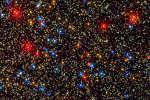 The Center of Globular Cluster Omega Centauri
14.09.2009
What is left over after stars collide? To help answer this question, astronomers have been studying the center of the most massive ball of stars in our Milky Way Galaxy. In the center of globular cluster Omega Centauri, stars are packed in 10,000 times more densely than near our Sun.
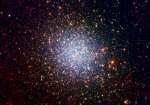 The Giants of Omega Centauri
1.05.2008
Globular star cluster Omega Centauri is some 15,000 light-years away and 150 light-years in diameter. Packed with about 10 million stars, Omega Cen is the largest of 200 or so known globular clusters that roam the halo of our Milky Way galaxy.
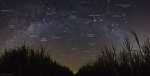 A Starry Night in Brazil
9.05.2009
This panoramic image tracing constellations in the southern sky shows off a beautiful vista toward the center of our Milky Way Galaxy. It was recorded just last month near the city of Campos in northeastern Rio de Janeiro state, Brazil.
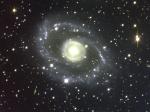 Spiral Galaxy In Centaurus
26.01.2000
Centaurus, the Centaur, is one of the most striking constellations in the southern sky. The lovely Milky Way flows through this large constellation whose celestial wonders also include the closest star to the sun, Alpha Centauri, the largest globular star cluster in our galaxy, Omega Centauri, and the closest active galaxy, Centaurus A.
 Spiral Galaxy In Centaurus
19.04.2003
Centaurus, the Centaur, is one of the most striking constellations in the southern sky. The lovely Milky Way flows through this large constellation whose celestial wonders also include the closest star to the sun, Alpha Centauri, the largest globular star cluster in our galaxy, Omega Centauri, and the closest active galaxy, Centaurus A.
 Globular Cluster 47 Tucanae
19.09.1997
Stars come in bunches. Of the over 200 globular star clusters that orbit the center of our Milky Way Galaxy, 47 Tucanae is the second brightest globular cluster (behind Omega Centauri). Known to some affectionately as 47 Tuc or NGC 104, it is only visible from the Southern Hemisphere.
 Globular Cluster 47 Tucanae
22.04.2001
Stars come in bunches. Of the over 200 globular star clusters that orbit the center of our Milky Way Galaxy, 47 Tucanae is the second brightest globular cluster (behind Omega Centauri). Known to some affectionately as 47 Tuc or NGC 104, it is only visible from the Southern Hemisphere.
 Globular Cluster 47 Tucanae
6.11.1998
Stars come in bunches. Of the over 200 globular star clusters that orbit the center of our Milky Way Galaxy, 47 Tucanae is the second brightest globular cluster (behind Omega Centauri). Known to some affectionately as 47 Tuc or NGC 104, it is only visible from the Southern
 Globular Star Cluster 47 Tuc
15.01.2011
Globular star cluster 47 Tucanae is a jewel of the southern sky. Also known as NGC 104, it roams the halo of our Milky Way Galaxy along with some 200 other globular star clusters.
 47 Tuc: A Great Globular Cluster of Stars
26.08.2008
Stars come in bunches. Of the over 200 globular star clusters that orbit the center of our Milky Way Galaxy, 47 Tucanae is the second brightest globular cluster (behind Omega Centauri). Light takes about...
|
January February March April May June July August September October |
|||||||||||||||||||||||||||||||||||||||||||||||||