
|
You entered: Ophiuchus
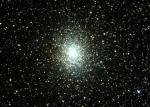 Globular Cluster M19
19.07.2000
M19 appears to be a typical globular cluster of stars - except for its shape. If one looks closely at the cluster, pictured above, it appears to be longer (top to bottom) than it is wide.
 NGC6366 vs 47 Ophiuchi
23.05.2025
Most globular star clusters roam the halo of our Milky Way galaxy, but globular cluster NGC 6366 lies close to the galactic plane. About 12,000 light-years away toward the constellation Ophiuchus, the cluster's starlight is dimmed and reddened by the Milky Way's interstellar dust when viewed from planet Earth.
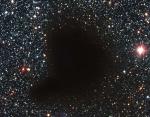 Molecular Cloud Barnard 68
23.09.2001
Where did all the stars go? What used to be considered a hole in the sky is now known to astronomers as a dark molecular cloud. Here, a high concentration of dust and molecular gas absorb practically all the visible light emitted from background stars.
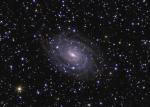 NGC 6384: Beyond the Stars
12.07.2007
The universe is filled with galaxies. But to see them astronomers must look out beyond the stars of our galaxy, the Milky Way. For example, consider this colorful telescopic view of spiral galaxy NGC 6384, about 80 million light-years away in the direction of the constellation Ophiuchus.
 APOD: 2024 October 27 Б LDN 43: The Cosmic Bat Nebula
27.10.2024
What is the most spook-tacular nebula in the galaxy? One contender is LDN 43, which bears an astonishing resemblance to a vast cosmic bat flying amongst the stars on a dark Halloween night. Located...
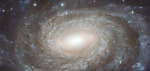 NGC 6384: Spiral Beyond the Stars
6.07.2013
The universe is filled with galaxies. But to see them astronomers must look out beyond the stars of our own galaxy, the Milky Way. This colorful Hubble Space Telescopic portrait features spiral galaxy NGC 6384, about 80 million light-years away in the direction of the constellation Ophiuchus.
 The Galaxy Above
15.10.2019
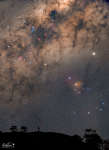
Have you contemplated your home galaxy lately? If your sky looked like this, perhaps you'd contemplate it more often! The featured picture is actually a composite of two images taken last month from the same location in south Brazil and with the same camera -- but a few hours apart.
 The Planet and the Pipe
7.06.2019
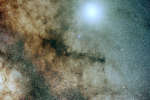
Now posing against our galaxy's rich starfields and nebulae, brilliant planet Jupiter shines in the night sky. Its almost overwhelming glow is near the top of the frame in this colorful telephoto portrait of the central Milky Way.
 Molecular Cloud Barnard 68
11.05.1999
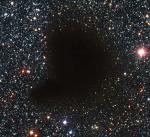
Where did all the stars go? What used to be considered a hole in the sky is now known to astronomers as a dark molecular cloud. Here, a high concentration of dust and molecular gas absorb practically all the visible light emitted from background stars.
 Messier 9 Close Up
23.03.2012
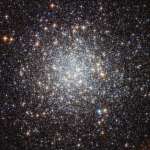
Renown 18th century astronomer Charles Messier described this 9th entry in his famous astronomical catalog as "Nebula, without star, in the right leg of Ophiuchus ...". But Messier 9 (M9) does have stars, known to modern astronomers as a globular cluster of over 300,000 stars within a diameter of about 90 light-years.
|
January February March April May June July August September |
|||||||||||||||||||||||||||||||||||||||||||||||||