
|
You entered: Perseus cluster
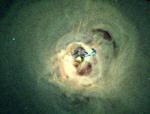 X Rays from the Perseus Cluster Core
8.12.2005
The Perseus Cluster of thousands of galaxies, 250 million light-years distant, is one of the most massive objects in the Universe and the brightest galaxy cluster in the x-ray sky. At its core lies the giant cannibal galaxy Perseus A (NGC 1275), accreting matter as gas and galaxies fall into it.
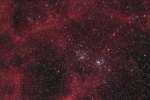 Double Cluster in Perseus
23.01.2014
This lovely starfield spans some seven full moons (about 3.5 degrees) across the heroic northern constellation of Perseus. Just right of center it holds the famous pair of open or galactic star clusters, h and Chi Perseii.
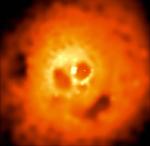 The Perseus Cluster s X Ray Skull
31.10.2000
This haunting image from the orbiting Chandra Observatory reveals the Perseus Cluster of Galaxies in x-rays, photons with a thousand or more times the energy of visible light. Three hundred twenty million light-years distant, the Perseus Cluster contains thousands of galaxies, but none of them are seen here.
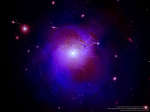 Unexpected X Rays from Perseus Galaxy Cluster
2.01.2018
Why does the Perseus galaxy cluster shine so strangely in one specific color of X-rays? No one is sure, but a much-debated hypothesis holds that these X-rays are a clue to the long-sought identity of dark matter.
 Unusual Gas Filaments Surround Galaxy NGC 1275
25.07.2005
How were the unusual gas filaments surrounding galaxy NGC 1275 created? No one is sure. Galaxy NGC 1275 is the central dominant galaxy of the Perseus Cluster of Galaxies, a cluster with many member galaxies visible in the above image. In visible light, NGC 1275 appears to show a spectacular collision between two distinct galaxies.
 Young Star Cluster NGC 1333
12.09.2024
This spectacular mosaic of images from the James Webb Space Telescope peers into the heart of young star cluster NGC 1333. A mere 1,000 light-years distant toward the heroic constellation Perseus, the nearby star cluster lies at the edge of the large Perseus molecular cloud.
 A Star Cluster Through Hale-Bopp's Tail
16.04.1997
Comet Hale-Bopp continues to look impressive. The photograph above captured the comet on April 7th passing nearly in front of M34, a star cluster in the constellation of Perseus. Many of the stars in this open cluster can be seen through Comet Hale-Bopp's white dust tail.
 Comet Machholz in View
5.01.2005
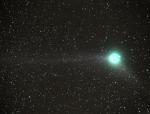
Good views of Comet Machholz are in store for northern hemisphere comet watchers in January. Now making its closest approach to planet Earth, the comet will pass near the lovely Pleiades star cluster on January 7th and the double star cluster in Perseus on January 27th as Machholz moves relatively quickly through the evening sky.
 The Double Cluster
4.12.2009
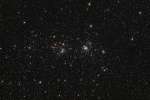
A lovely starfield in the heroic northern constellation Perseus holds this famous pair of open or galactic star clusters, h and Chi Perseii. Also cataloged as NGC 869 (right) and NGC 884, both clusters are about 7,000 light-years away and contain stars much younger and hotter than the Sun.
 NGC 1275: A Galactic Collision
5.05.2003
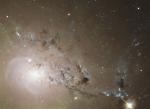
In NGC 1275, one galaxy is slicing through another. The disk of the dusty spiral galaxy near the image center is cutting through a large elliptical galaxy, visible predominantly on the lower left. Galaxies...
|
January February March April May June July August September October |
|||||||||||||||||||||||||||||||||||||||||||||||||