
|
You entered: SMC
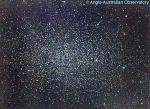 Nearby Dwarf Galaxy Leo I
3.10.1999
Leo I is a dwarf spheroidal galaxy in the Local Group of galaxies dominated by our Milky Way Galaxy and M31. Leo I is thought to be the most distant of the eleven known small satellite galaxies orbiting our Milky Way Galaxy.
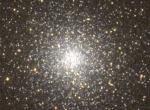 Globular Cluster 47 Tucanae
19.09.1997
Stars come in bunches. Of the over 200 globular star clusters that orbit the center of our Milky Way Galaxy, 47 Tucanae is the second brightest globular cluster (behind Omega Centauri). Known to some affectionately as 47 Tuc or NGC 104, it is only visible from the Southern Hemisphere.
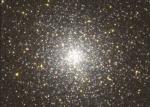 Globular Cluster 47 Tucanae
22.04.2001
Stars come in bunches. Of the over 200 globular star clusters that orbit the center of our Milky Way Galaxy, 47 Tucanae is the second brightest globular cluster (behind Omega Centauri). Known to some affectionately as 47 Tuc or NGC 104, it is only visible from the Southern Hemisphere.
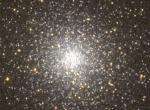 Globular Cluster 47 Tucanae
7.11.1998
Stars come in bunches. Of the over 200 globular star clusters that orbit the center of our Milky Way Galaxy, 47 Tucanae is the second brightest globular cluster (behind Omega Centauri). Known to some affectionately as 47 Tuc or NGC 104, it is only visible from the Southern
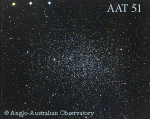 Nearby Dwarf Galaxy Leo I
19.05.1996
Leo I is a dwarf spheroidal galaxy in the Local Group of galaxies dominated by our Milky Way Galaxy and M31. Leo I is thought to be the most distant of the eleven known small satellite galaxies orbiting our Milky Way Galaxy.
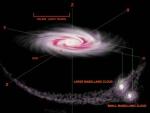 The Magellanic Stream
26.08.1998
Spanning the sky behind the majestic Clouds of Magellan is an unusual stream of gas: the Magellanic Stream. The origin of this gas might hold a clue to origin and fate of our Milky Way's most famous satellite galaxies: the LMC and the SMC.
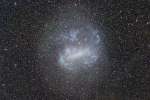 A Large Magellanic Cloud Deep Field
9.04.2008
Is this a spiral galaxy? No. Actually, it is the Large Magellanic Cloud (LMC), the largest satellite galaxy of our own Milky Way Galaxy. The LMC is classified as a dwarf irregular galaxy because of its normally chaotic appearance. In this deep and wide exposure, however, the full extent of the LMC becomes visible.
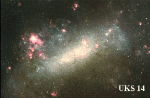 The Large Cloud Of Magellan (LMC)
24.01.1998
Ferdinand Magellan and his crew had plenty of time to study the southern sky during their famous voyage around the world. As a result, two fuzzy cloud-like objects, not visible to northern hemisphere dwellers, are now known as the Clouds of Magellan.
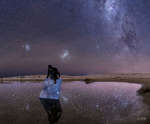 Night Sky Reflected
13.09.2021
What's that in the mirror? In the featured image of the dark southern sky, the three brightest galaxies of the night are all relatively easy to identify. Starting from the left, these are the Small Magellanic Cloud (SMC), the Large Magellanic Cloud (LMC), and part of the central band of our Milky Way Galaxy.
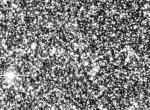 Sparkling Star May Indicate Galactic Composition
24.06.1998
If a star in this photograph twinkled slightly, would anyone notice? Would anyone care? Astronomers with the MACHO Collaboration noticed one such twinkle just last week, and many members of the astronomical community now care.
|
January February March April May June July August September October |
|||||||||||||||||||||||||||||||||||||||||||||||||