
|
You entered: Swift
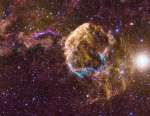 Sibling Supernova Remnants
1.07.2026
What happens when one of the stars in a binary goes supernova? This image combines visible (yellow), ultraviolet (purple) and infrared light (cyan, red and orange) to show two supernova remnants and their surrounding environment, about 6,000 light-years away. The younger one is the well-known Jellyfish Nebula in the center (mostly in yellow).
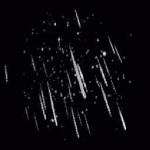 The Perseid Meteor Shower
9.08.1996
From a radiant point in the constellation of Perseus, Comet Swift-Tuttle presents -- The Perseid Meteor Shower -- coming to your night sky this weekend! A bookish E. C. Herrick of New Haven, Connecticut correctly suspected in 1837 that this meteor shower was an annual event.
 Earths Major Telescopes Investigate GRB 130427A
8.05.2013
A tremendous explosion has occurred in the nearby universe and major telescopes across Earth and space are investigating. Dubbed GRB 130427A, the gamma-ray burst was first seen by the Earth-orbiting Swift satellite in high energy X-rays and quickly reported down to Earth.
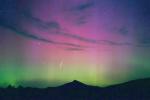 A Perseid Aurora
21.08.2000
Just after the Moon set but before the Sun rose in the early morning hours of August 12, meteors pelted the Earth from the direction of the constellation Perseus, while ions pelted the Earth from the Sun.
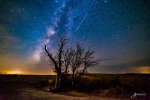 Comet Dust over Enchanted Rock
13.08.2015
Dusty debris from periodic Comet Swift-Tuttle was swept up by planet Earth this week. Vaporized by their passage through the dense atmosphere at 59 kilometers per second, the tiny grains produced a stream of Perseid meteors. A bright, colorful Perseid meteor flash was captured during this 20 second exposure.
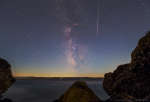 Perseid by the Sea
15.08.2017
Just after moonrise on August 12 this grain of cosmic sand fell by the sea, its momentary flash part of the annual Perseid Meteor Shower. To create the Perseid meteors, dust along the orbit of periodic comet Swift-Tuttle is swept up by planet Earth.
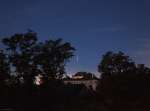 Perseid over Albrechtsberg Castle
25.08.2012
Medieval Albrechtsberg castle is nestled in trees near the northern bank of the river Pielach and the town of Melk, Austria. In clearing night skies on August 12 it stood under constellations of the northern summer, including Aquarius, Aquila, and faint, compact Delphinus (above and right of center) in this west-looking skyview.
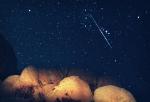 Bright Meteor, Dark Sky
20.08.1997
Has Orion the Hunter acquired a new weapon? If you turn your head sideways (counterclockwise) you might notice the familiar constellation of Orion, particularly the three consecutive bright stars that make up Orion's belt.
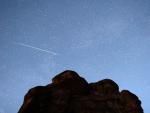 Comet Dust over Colorado
17.08.2006
The rock formation in the foreground of this night view was recorded on August 10, illuminated by light from a waning gibbous Moon. Even though the sky above also scatters the bright moonlight, a brilliant meteor was captured as it flashed across the scene during the 30 second long exposure.
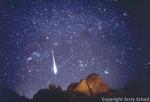 A Meteor Over the Anza Borrego Desert
11.08.1999
Meteors will be flashing across your skies over the next two nights. Specifically, the Perseid Meteor Shower should be at its best just before each morning's dawn. Observers at dark locations might see as much as a meteor a minute.
|
January February March April May June July August |
||||||||||||||||||||||||||||||||||||||||||||||||||||||||