
|
You entered: Tethys
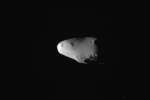 An Unusually Smooth Surface on Saturns Calypso
16.02.2010
Why is this moon of Saturn so smooth? This past weekend, humanity's Saturn-orbiting Cassini spacecraft passed as close to Saturn's small moon Calypso as it ever has, and imaged the small moon in unprecedented detail. Pictured above is an early return, raw, unprocessed image of the 20-km long irregularly shaped moon.
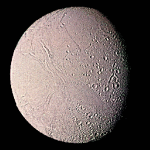 Saturn's Cleanest Moon: Enceladus
24.11.1995
Enceladus orbits Saturn between the smaller Mimas and the larger Tethys. Enceladus is composed mostly of water ice and has the cleanest and purest ice surface in the Solar System. It's surface therefore appears nearly white. The surface also has many unusual groves and relatively few craters, like Jupiter's moon Ganymede.
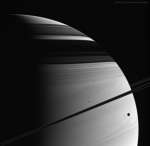 Moons, Rings, Shadows, Clouds: Saturn (Cassini)
1.04.2018
While cruising around Saturn, be on the lookout for picturesque juxtapositions of moons, rings, and shadows. One quite picturesque arrangement occurred in 2005 and was captured by the then Saturn-orbiting Cassini spacecraft. In the featured image, moons Tethys and Mimas are visible on either side of Saturn's thin rings, which are seen nearly edge-on.
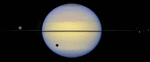 Saturns Rings Seen Sideways
18.10.1998
Saturn's rings are actually very thin. This picture from the Hubble Space Telescope was taken on August 6, 1995 when the rings lined up sideways as seen from Earth. Saturn's largest moon Titan is seen on the left, and Titan's shadow can be seen on Saturn's cloud tops!
 Infrared Saturn
24.07.1999
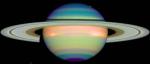
This delightfully detailed false color image of Saturn was earmarked to celebrate the 8th anniversary of the orbiting Hubble Space Telescope. The picture is a combination of three images taken in January 1998 and shows the lovely ringed planet in reflected infrared light.
 APOD: 2026 June 16 Б Moons, Rings, Shadows, Clouds: Saturn Cassini
15.06.2026
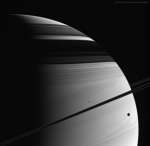
While cruising around Saturn, be on the lookout for picturesque arrangements of moons, rings, and shadows. One such striking sight occurred in 2005 and was captured by the then Saturn-orbiting Cassini spacecraft.
 Saturn's Rings Seen Sideways
24.05.1997
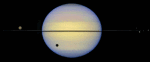
Saturn's rings are actually very thin. This picture from the Hubble Space Telescope was taken on August 6, 1995 when the rings lined up sideways as seen from Earth. Saturn's largest moon Titan is seen on the left, and Titan's shadow can be seen on Saturn's cloud tops!
 Infrared Saturn
24.04.1998
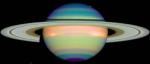
This delightfully detailed false color image of Saturn has been earmarked to celebrate the 8th anniversary of the orbiting Hubble Space Telescope. The picture is a combination of three images taken in January of this year with the Hubble's new NICMOS instrument and shows the lovely ringed planet in reflected infrared light.
 Saturn's Rings Seen Sideways
29.04.1996
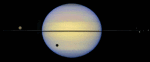
Saturn's rings are actually very thin. This picture from the Hubble Space Telescope was taken on August 6, 1995 when the rings lined up sideways as seen from Earth. Saturn's largest moon Titan is seen on the left, and Titan's shadow can be seen on Saturn's cloud tops!
 Six Moons of Saturn
14.04.2012
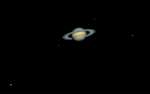
How many moons does Saturn have? So far 62 have been discovered, the smallest only a fraction of a kilometer across. Six of its largest satellites can be seen here, though, in a sharp Saturnian family portrait taken on March 9.
|
January February March April May June July August September |
|||||||||||||||||||||||||||||||||||||||||||||||||