
|
You entered: accretion disk
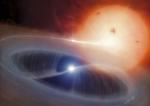 An Intermediate Polar Binary System
21.05.2006
How can two stars create such a strange and intricate structure? Most stars are members of multiple-star systems. Some stars are members of close binary systems where material from one star swirls around the other in an accretion disk.
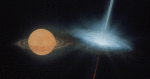 Jets From SS433
6.03.1996
SS433 is one of the most exotic star systems known to astronomers. Its unremarkable name stems from its inclusion in a catalog of stars which emit radiation characteristic of atomic hydrogen. Its very remarkable behavior stems from a compact object, a black hole or neutron star, which has produced an accretion disk with jets.
 Mira: The Wonderful Star
22.07.2006
To seventeenth century astronomers, Omicron Ceti or Mira was known as a wonderful star - a star whose brightness could change dramatically in the course of about 11 months. Modern astronomers now recognize an entire class of long period Mira-type variables as cool, pulsating, red giant stars, 700 or so times the diameter of the Sun.
 Mira: The Wonderful Star
5.05.2005
To seventeenth century astronomers, Omicron Ceti or Mira was known as a wonderful star - a star whose brightness could change dramatically in the course of about 11 months. Modern astronomers now recognize an entire class of long period Mira-type variables as cool, pulsating, red giant stars, 700 or so times the diameter of the Sun.
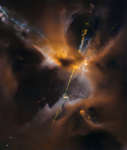 Herbig Haro 24
18.12.2015
This might look like a double-bladed lightsaber, but these two cosmic jets actually beam outward from a newborn star in a galaxy near you. Constructed from Hubble Space Telescope image data, the stunning scene...
 Herbig Haro 24
28.05.2025
This might look like a double-bladed lightsaber, but these two cosmic jets actually beam outward from a newborn star in a galaxy near you. Constructed from Hubble Space Telescope image data, the stunning scene...
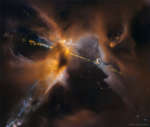 Duel Particle Beams in Herbig Haro 24
11.03.2018
This might look like a double-bladed lightsaber, but these two cosmic jets actually beam outward from a newborn star in a galaxy near you. Constructed from Hubble Space Telescope image data, the stunning scene...
 Recurrent Nova RS Ophiuci
24.02.2006
This pretty star field in the constellation Ophiucus is centered on a star not often seen - RS Ophiuci. In fact, early last week RS Oph suddenly became visible to the naked eye for the first time since 1985.
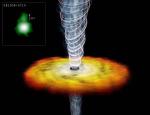 The Most Distant X Ray Jet
28.11.2003
A false-color x-ray image inset at upper left reveals emission from a cosmic jet of high-energy particles, 100,000 light-years in length, emerging from quasar GB1508+5714. An estimated 12 billion (12,000,000,000) light-years away, this appears to be the most distant energetic jet in the known Universe.
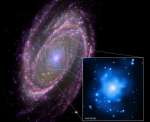 M81: Feeding a Black Hole
27.06.2008
This impressive color composite shows spiral galaxy M81 across the electromagnetic spectrum. It combines X-ray data (blue) from the Chandra Observatory, infrared data (pink) from the Spitzer Space Telescope, and an ultraviolet image (purple) from the GALEX satellite, with a visible light (green) Hubble image.
|
January February March April May June July August September |
|||||||||||||||||||||||||||||||||||||||||||||||||